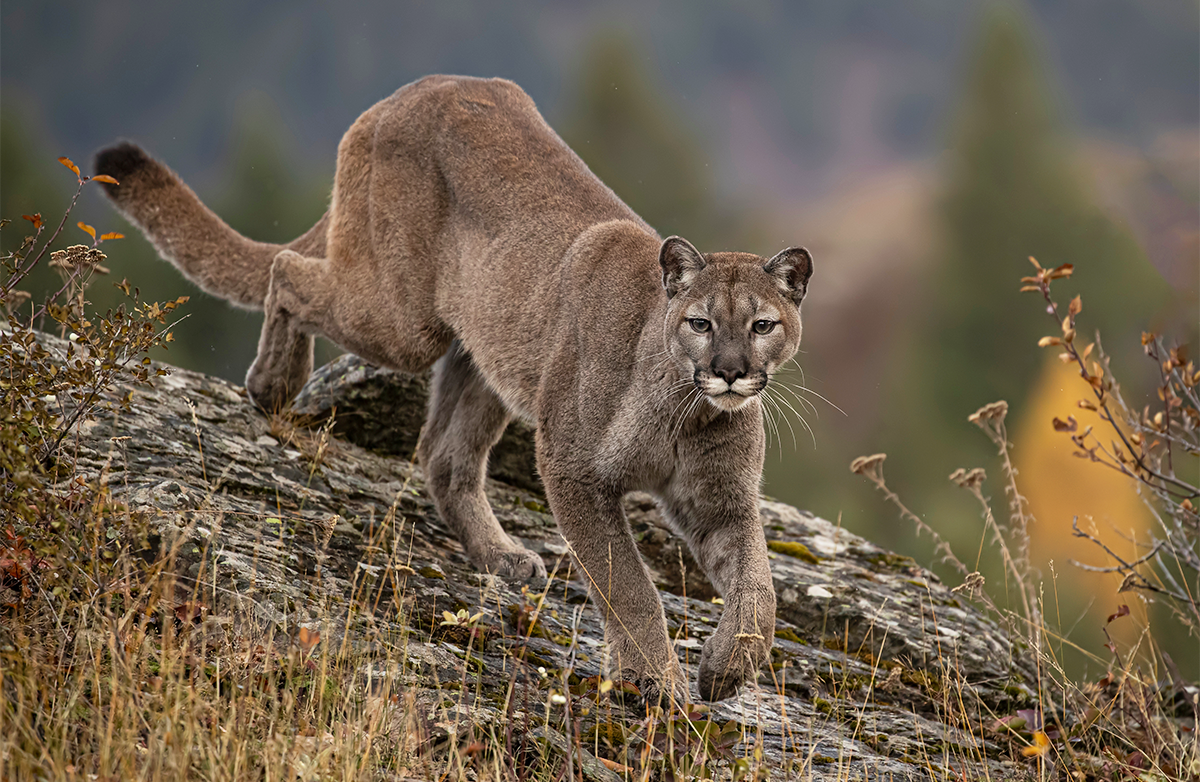
It’s natural to shudder at the thought of a big, predatory animal staring you down. Mountain lions were eliminated from the eastern United States in large part because of our fear of them. And as they make a comeback in the west, mountain lions, or “pumas” (Puma concolor), are certainly coming into conflict with humans. That said, there’s evidence that mountain lions will predictably avoid places with lots of people. In fact, a new study published today in Current Biology shows that having them around actually makes us safer.
A collaboration of biologists, led by Conservation Science Partners in California and including experts from several western Native American tribes, found that the presence of pumas made wildlife-vehicle collisions significantly less likely on Washington State’s Olympic Peninsula. “Carnivores can make roadways safer through their effects on prey behavior and space use,” explained lead author Justin Suraci in a press release.
From July 2020 to June 2025, black-tailed deer accounted for 92 percent of wildlife-vehicle collisions on the Olympic Peninsula, which included two human deaths and more than 80 injuries. Yet, the geographic distribution of such collisions varied widely, prompting the question of whether pumas played a role since black-tailed deer (Odocoileus hemionus columbianus) are the primary prey of pumas in that region.
Read more: “When We Were Lunch”
The researchers compiled data from 503 camera traps and 59 GPS-collared pumas that are part of Tribal biology studies across the peninsula, then assessed the relationship between puma presence and deer collisions. They discovered that when pumas were present, deer were more active during the day, reducing their dangerous forays onto roadways at night, with an estimated 67-percent reduction in the likelihood of a deer-vehicle collision. “Deer try to avoid risk from pumas and, in doing so, spend less time near roads,” explained Suraci.
Deer density increased with roadways because black-tailed deer prefer grazing along forest edges—something pumas may be aware of, which is why they have high hunting success there. The deer, though, have apparently gotten wise to them, and as such, puma presence appears to repel deer from landscapes that are more fragmented by roads.
As pumas slowly recolonize parts of their former range, including the eastern U.S., understanding the “road safety service” they provide may lessen our objections to sharing habitats with them and help their population rebound. The same goes for other seemingly terrifying predators.
Or as Suraci put it, “Carnivores may well be providing a similar road safety service elsewhere around the globe where populations have persisted, and this valuable ecosystem service has just gone unnoticed to date.” 
Enjoying Nautilus? Subscribe to our free newsletter.
Lead image: Carol / Adobe Stock