In 2012, Tim Shaw was still living the rarefied, enviable life of an NFL player. He’d played in college, in Penn State’s storied program, then got drafted, and did his most productive work with the Tennessee Titans, becoming their special-teams captain in 2011 and 2012. But around the end of the year, his body started acting strangely: His muscles twitched, his balance was off. The next year, at age 29, he got cut, having played the last football of his life.
Last month Shaw announced the source of his problems to the world in a poignant version of the viral Ice Bucket Challenge: He had been diagnosed with ALS. In his video, he was asking people to support research on the disease that ended his NFL career and will likely end his life within the next several years.
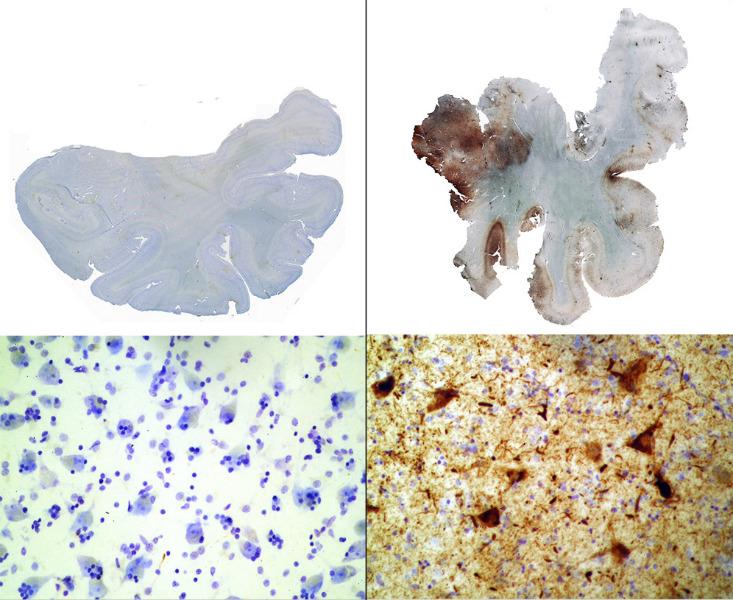
Over the past few years, football’s brain-injury problem has gotten as big as a set of 350-pound linemen. The most visible issue is CTE, chronic traumatic encephalopathy, a brain disease that causes depression and dementia, and has been shown to result from concussions. CTE can only be positively diagnosed after death—the victims’ brains bear a distinctive, abnormal form of a so-called tau protein, which form tangles that destroy brain cells. Head trauma also leads to elevated levels of Alzheimer disease and ALS, both of which are about four times as common in football players, like Tim Shaw, than the general populace.
As much as we’ve learned about the effects of brain injuries sustained in football—much of it coming from one lab at Boston University that analyzes athletes’ brains post-mortem—some of the biggest questions remain unanswered: We don’t know which people are genetically susceptible to long-term injuries, nor how many concussions, of what severity, will cause them. We’ll most likely never know for sure whether Tim Shaw’s ALS was the result of football injuries, but under the assumption that it was, he will be eligible to receive the maximum $5 million as part of the settlement recently agreed to by the NFL and former players.
In order to get more useful data, researchers are starting to rig football helmets with accelerometers that determine the forces that players’ brains are subject to. For the past decade, Kevin Guskiewicz, a leading concussion researcher at the University of North Carolina, has used sensors to record and study several hundred thousand head impacts involving the university’s football team. Last year Guskiewicz ran a pilot program installing the sensors in the helmets of two NFL teams, and this year the program was expanded to include more teams.
These new sensors raise hopes that helmets could work like dosimeters—people who are exposed to radiation in their work, like nuclear-plant workers, are required to wear devices that measure how much radiation they’re absorbing and send out alerts when people have exceeded safe limits. Similarly, acceleration data from football helmets could be fed into a program that calculates risk of long-term injury based on the force, direction, location, and number of impacts, and then warns when it’s time for a player to sit out awhile.
But like so much about brain injuries, the relationship between impact forces and brain injury is not easy to untangle. Guskiewicz says his data shows a collision involving 60G of acceleration will at times cause a concussion, while another at 160G may not. This means that the raw data from helmet sensors is not useful by itself for diagnosing brain damage. “My biggest fear is that people automatically think this is a concussion diagnostic tool, and it is not,” says Guskiewicz. “With, like, four exclamation points I want to make that clear.”
So, for now at least, the helmet sensors are useful only as a general indicator of techniques that tend to lead to big impacts and specific, high-acceleration collisions that might cause health problems. Over the long term, though, comparing data on collisions over a player’s career with their neurological health later in life may prove useful in getting a better handle on the risk factors. The new helmets may do more to protect future football players than the players who are actually wearing them.
Amos Zeeberg is Nautilus’ digital editor.