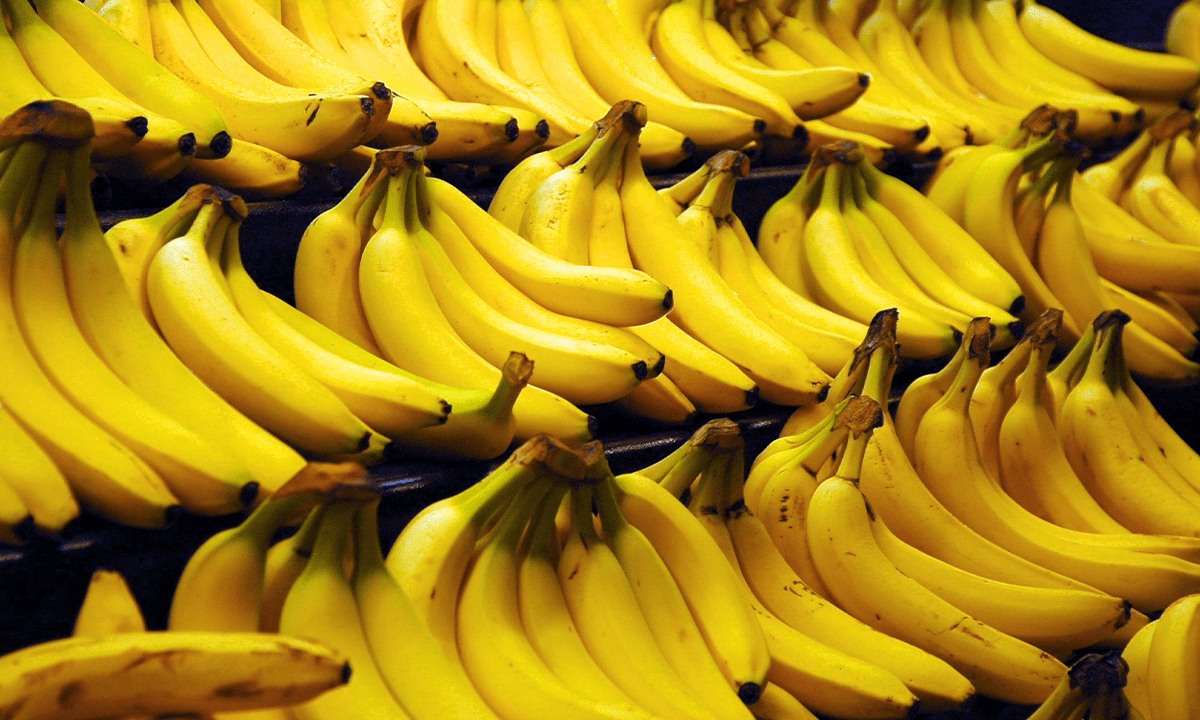
Have you ever wondered why you don’t have to spit out seeds after snacking on a banana? It’s because the Cavendish, the most widely used commercial cultivar, has three copies of chromosomes and can’t produce fertile seeds. Instead, the Cavendish is propagated by cloning, which is convenient for maintaining consistent banana quality, but leaves the plant vulnerable to disease.
It’s a fate that befell the Cavendish’s predecessor, the Gros Michel (French for “Big Mike”). This more flavorful cultivar was the most widely available banana for decades until it fell victim to the wilting fungus Fusarium, known by the colloquial name “Panama disease.” By the 1950s, Gros Michel bananas had all but disappeared, and the Cavendish became the dominant cultivar, accounting for 99 percent of banana exports today.
For years, the Cavendish was thought to be resistant to the soil-borne Panama disease, until the 2010s when a virulent strain of the fungus, Tropical Race 4, started spreading. With bananas under threat worldwide, the race to protect the Cavendish from suffering the Gros Michel’s fate began. Now, agricultural scientists are making headway with new research published in Horticulture Research.
Read more: “What’s Wrong with Bananas”
Andrew Chen and Elizabeth Aitken from the University of Queensland recently pinpointed the location of a gene in the wild banana plant—Calcutta 4—that confers resistance to Fusarium wilt, Sub Tropical Race 4 (STR4).
“We’ve located the source of STR4 resistance in Calcutta 4 which is a highly fertile wild diploid banana by crossing it with susceptible bananas from a different subspecies of the diploid banana group,” Chen explained in a statement. “This is a very significant finding; it is the first genetic dissection of Race 4 resistance from this wild subspecies.”
Because the banana plant crosses had to grow for a year before they could be checked for disease-resistance, locating the gene took five years. You may be wondering why we can’t just make the switch from the Cavendish to Calcutta 4 the way we swapped the Cavendish for the Gros Michel.
“While Calcutta 4 provides crucial genetic resistance, it isn’t suitable as a commercial cultivar because it doesn’t produce fruit which are good to eat,” Chen said.
Going forward, the researchers are developing molecular markers for the gene so banana producers can more efficiently identify and plant resistant seedlings. “This will speed up selection, reduce costs and hopefully ultimately lead to a banana that is good to eat, easy to farm, and naturally protected from Fusarium wilt through its genetics,” Chen said.
That is, until the fungus adapts once more. 
Enjoying Nautilus? Subscribe to our free newsletter.
Lead image: Steve Hopson / Wikimedia Commons