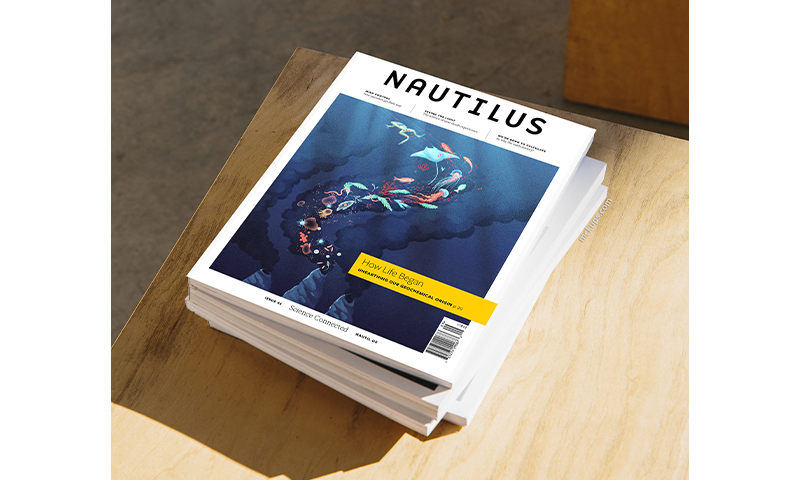
It was a pleasure bringing together Philip Ball and Nick Lane for this issue’s cover story. A pleasure because Ball and Lane are two of my favorite science writers. Both translate the daunting languages of biology and physics and more into lucent articles and books that make us feel we are fluent speakers in complex science ourselves. In “The Big Thinker,” Ball plumbs the depths of Lane’s research into how life first arose on Earth. Learning how inorganic minerals catalyzed into organic cells is not for the faint of mind. Fear not. Ball frames Lane’s bold science in a warm and engaging profile.
Ball has crossed paths with Lane, a professor of evolutionary biochemistry at University College London, several times over the years. A couple of years ago at a science conference, Ball ran into Lane, who told him he was writing a book about the Krebs cycle, the bane of students, a dry foundation of biochemistry. “The Krebs cycle is basically extremely dull even to the people who work on it,” Lane said. “And yet somehow it’s making me excited. I remember reading Primo Levi, who said a good writer should be able to make any subject interesting. And maybe I took that as a challenge.”

Ball has taken the same challenge. In “Behind the Scenes,” which appears every Sunday in our email newsletter, Ball told Nautilus associate editor Brian Gallagher, “I studied as a chemist at Oxford University and went on to do a Ph.D. in physics at the University of Bristol. I joined Nature in 1988 when it was a very different era in science communication and a very different journal. Today, Nature is a big publishing empire. In those days, it was just a single journal run out of a relatively small office with a very small staff. That meant as editors we had to cover a lot of ground, and so it was a very steep learning curve. It could be that if my colleague was away for one week who handled astronomy, then I would be handling the astronomy papers or the Earth sciences papers.”
As an editor, Ball explained, he grew increasingly restless to write. “I gradually went part time, and that part time got smaller and smaller, and the writing got bigger and bigger,” he said. “Around the turn of the millennium, I decided to go completely freelance and just focus on writing, and that’s what I’ve been doing ever since. Now I feel fortunate to make a living by being able to follow my own curiosity and interest, and to spend two or three years really digging into a particular subject that interests me and writing a book about it.”
Ball’s books constitute a cabinet of wonders. Open them to explore art and the invention of color, a secret history of China, a biography of water, our music instinct, the patterns of nature, the world of Renaissance magic and science, and the nature of curiosity. His most recent book, The Book of Minds, gently explains that humans are not the kings of the jungle, that the road to understanding our own minds, and selves, begins with appreciating the unique minds of other beings, from animals to artificial intelligences to aliens.
With this issue, as always, we’re proud and delighted to have Ball bring his original mind to yours.