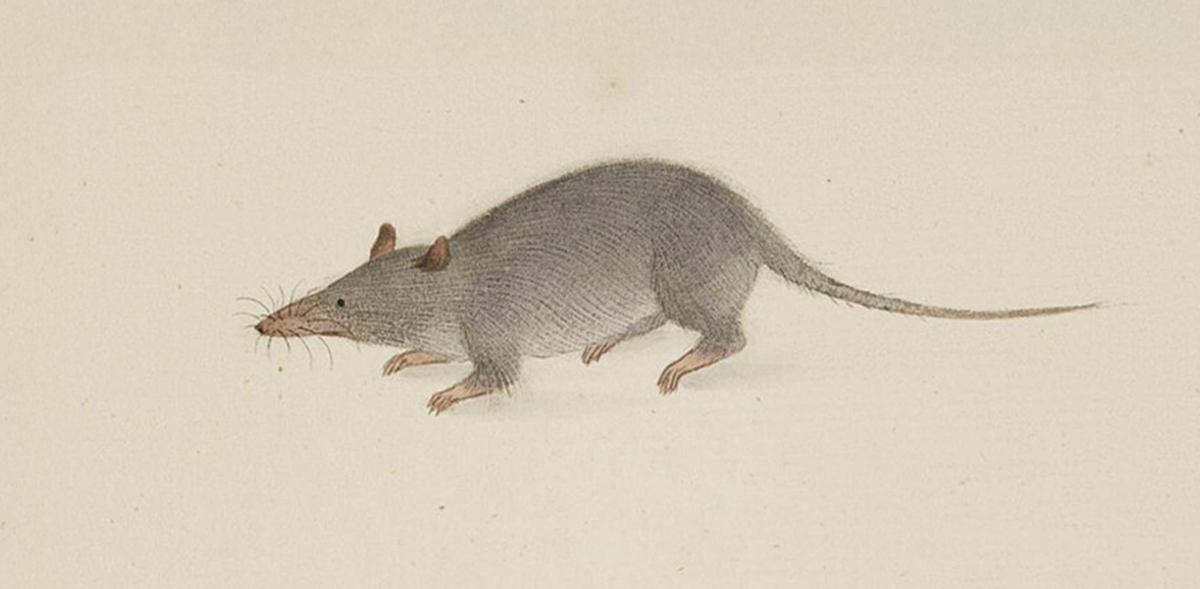
If you find chew holes in your packages of food in North America, you suspect a mouse. But, in Asia, it might be a shrew invading your pantry. Its pencil-point snout and musky odor give the Asian house shrew (Suncus murinus) away. Native to the Indian subcontinent, it has spread as far east as Japan and as far west as Africa. Like many pests, it was a stowaway on migrations of humans.
A recent study published in the Zoological Journal of the Linnean Society used Asian house shrew DNA to track routes of human migration and trade across Asia. Led by environmental scientists at Hokkaido University in Japan, the study sampled shrews throughout their geographic range to ascertain their patterns of gene flow.
“Historical documents and archaeological evidence provide only part of the story of human history,” explained lead author Satoshi Ohdachi in a press release. And so, tracking the populations of animals that we intentionally or inadvertently bring with us helps round out the picture of our own dispersal.
Read more: “Hitler and the Naming of the Shrew”
The researchers sequenced whole genomes from 21 shrews, and drew upon existing sequence data for eight more shrews, covering Madagascar, Yemen, the Indian subcontinent, and the Ryukyu Islands of Japan. A supplementary analysis of the cytochrome b region of DNA, useful for determining relatedness, included 219 house shrews.
The findings demonstrate that the Asian house shrews didn’t just spread from a big migration event. Rather, they capitalized on multiple waves of human dispersal over time. Plotting their gene flow, the results revealed a previously unknown network of human movements between Iran, Yemen, East Africa, islands in the Indian Ocean, and West and Southeast Asia.
“This region was shaped not by a single trade network, but by many interconnected regional exchanges over the last 10,000 years or so,” explained Ohdachi.
For example, Asian house shrews were introduced to Japan at least twice based on their distinct genomics in the Ryukyu Islands versus the adjacent Kyushu Island. Meanwhile, shrews in southwestern Iran are closely related to shrews from the island of Zanzibar just off Tanzania. And shrews on the islands further eastward, such as Mauritius, are linked to Southeast Asian lineages.
The researchers concluded that Asian house shrews initially spread locally in the Indian subcontinent through agriculture, then later hitchhiked rides farther afield with humans migrating and trading goods.
In other words, we only have ourselves to blame for house shrews tearing holes into our food. 
Enjoying Nautilus? Subscribe to our free newsletter.
Lead image: Ishizaki Yūshi - Naturalis Biodiversity Center / Wikimedia Commons