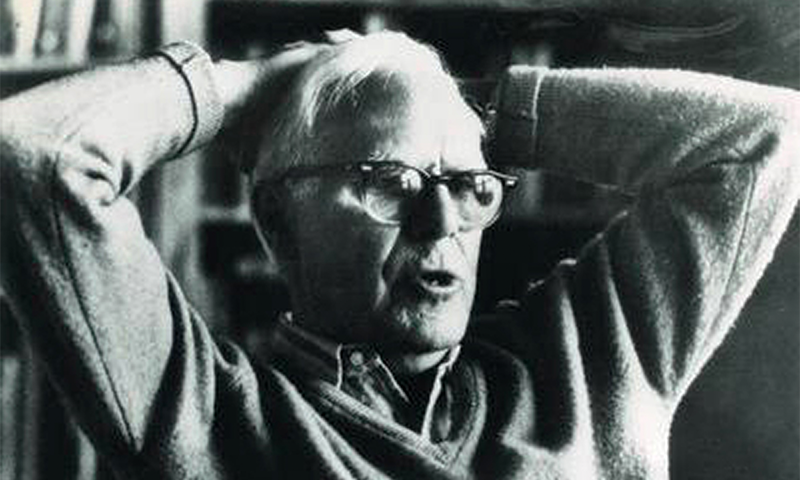
Martin Gardner, who is honored today with Celebration of the Mind Day, brought math to the masses. For 25 years, Gardner drafted a puzzle column for Scientific American, one of the most popular features of the magazine. Known for these delightful puzzles, as well as for a lifetime of magic tricks and a prolific pen, Gardner believed math and magic were one and the same. He wanted everyone to find math magical, or “mathemagical,” as he called it.
After Gardner’s death in 2010, Celebration of the Mind Day was established on his birthday, October 21. Hosted by the Gathering 4 Gardner Foundation, the holiday coincides with a worldwide series of events that aims to bring people together to celebrate the pleasures of puzzles, math games, and of course, magic.
Gardner had no advanced training in mathematics himself, but he believed this was one of his strengths, as it helped him to communicate with people. In his memoirs, Undiluted Hocus-Pocus, published posthumously in 2013, he writes, “One of the pleasures in writing the [Scientific American] column was that it introduced me to so many top mathematicians, which of course I was not. Their contributions were far superior to anything I could write, and were a major reason for the column’s growing popularity. The secret of its success was a direct result of my ignorance.” The column, called simply “Mathematical Games,” launched in January of 1957 after one of his puzzles, about so-called “Flexagons,” became a huge hit.
Gardner developed an interest in magic and illusions early on, first writing about one of his magic tricks for a magazine called The Sphinx at the tender age of 15. It was a pursuit he followed for the rest of his life. He was most interested in table and close-up magic and published many original tricks. He was proudest of a card trick known as the Wink Change, but he also invented so-called “tapping” and “spelling” effects. (You can find a sampling of his magic tricks here.)
Gardner was a prolific writer as well, authoring short stories, a novel, essays, and more than 100 books on subjects ranging from physics to philosophy to rationality to skepticism, and of course recreational mathematics and puzzles. He was also considered a leading authority on Lewis Carroll and was widely known for his annotated versions of Alice in Wonderland and Through the Looking Glass, which revealed the secret mathematical and literary riddles and references sprinkled throughout the books.
Gardner was devoted to debunking pseudoscience throughout his lifetime and is considered the founder of the skeptic movement. He created the Committee for Skeptical Inquiry in 1976 and wrote a monthly column for the Skeptical Inquirer. American paleontologist, evolutionary biologist, and historian of science Stephen Jay Gould called him “the single brightest beacon defending rationality and good science against the mysticism and anti-intellectualism that surrounded us.”
Revisiting Gardner’s work is a welcome reminder of the power of playful inquiry to engage minds. 
Lead image: Konrad Jacobs / Wikimedia