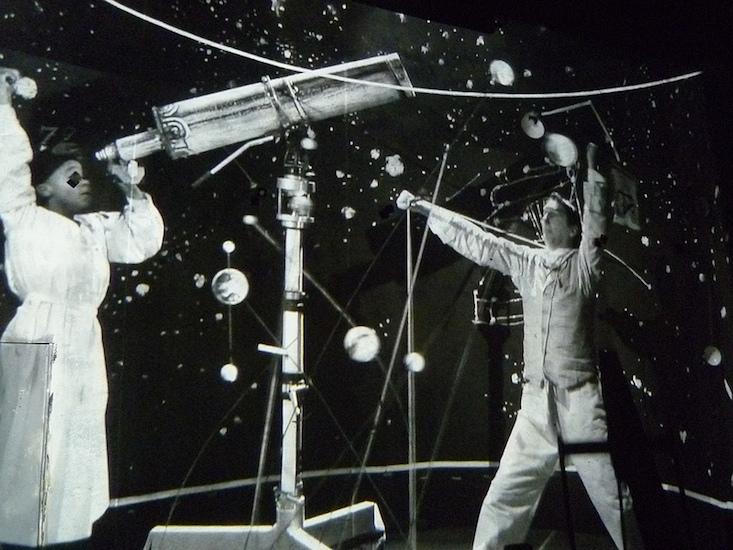
In Gallery 919, in New York’s Metropolitan Museum of Art, there is a giant breathing machine. Its creator, William Kentridge, calls it “the elephant,” after Charles Dickens’s description of factory machines that move “monotonously up and down, like the head of an elephant in a state of melancholy madness.” On the walls surrounding the elephant are five different video channels, full of metronomes, maps, springs, people in white coats, stars.
The installation, called The Refusal of Time, is a collaboration between Kentridge and historian of science (and Nautilus advisor) Peter Galison. Both men are fascinated by time—how we’ve measured it, how it works, and whether it’s real at all. In a related essay, also titled “The Refusal of Time,” Galison recounts Einstein’s relationship with Friedrich Adler—a student who quit physics to work in politics and later assassinated an Austrian politician for his WWI-era policies. Adler and Einstein were close friends, corresponding about physics long after Adler was arrested and jailed for murder. But as Galison documents in the essay, Adler could never come to grips with the idea that Einstein and Poincare both settled on: that time was relative, not absolute.
Perhaps this is what The Refusal of Time, with its pumping elephant and looping video tracks, is trying to show us. The whole thing loops for a half an hour, but you would never know it unless you timed it yourself. The New Yorker puts it this way: “Kentridge insists on, and creates, such an elastic sense of duration that, if you stay for the video’s entire half hour, by the end, the very concept of minutes and hours may strike you as hopelessly quaint.” It loops through our changing comprehension of time—from watching the heavens, to measuring it with clocks, to Einstein’s attack on its absoluteness, to whatever the future might hold.
Galison ends his essay with an exploration of how, in the universe of relative time, one might actually destroy information. “According to some key general relativists, an encyclopedia could fall in [to a black hole]—but no messages, not the slightest message, can escape,” he writes. “John Wheeler (who coined the name ‘black hole’) says, ‘Every black hole brings an end to time and space and the laws of physics.” According to Stephen Hawking’s famous work in the 70s, black holes gradually boil away, leaving nothing behind—no information, no matter, nothing. If that’s true, black holes are different from other parts of physics, like electromagnetism, which do not point to any end of time—they’re the same backwards and forwards.
But not everyone agrees with that view of black holes. “According to many leading quantum (string) theorists, all the information of the world encyclopedia stays there, forever, scrambled, like sparkling ashes from a fire, but still there, still inscribed on the surface of a bubble,” writes Galison. Just last month, Stephen Hawking himself advanced a new idea about how information might be preserved in, and escape from, a black hole; it depends on hypothetical chaotic activity, where space-time itself fluctuates, at the very edge of the black hole. But Hawking’s paper is not peer-reviewed, and it’s already drawn substantial disagreement.
And while string theory might save the information in a black hole, writes Galison, it may do still stranger things to time, which in some physicists’ views “becomes an illusion, like our sense that water is smooth because our hands are too coarse to sense the atoms that make it up.”
Even in this modern time, the idea of time continues to vex.
Rose Eveleth is Nautilus’ special media manager.