Solar flares can wreak havoc on Earth, disrupting radio communications, knocking out electricity, and causing satellites to crash. “Even signals on railway lines can be affected and switch from red to green or vice versa,” explained Louise Harra of the Davos Physical Meteorological Observatory. “That’s really scary.”
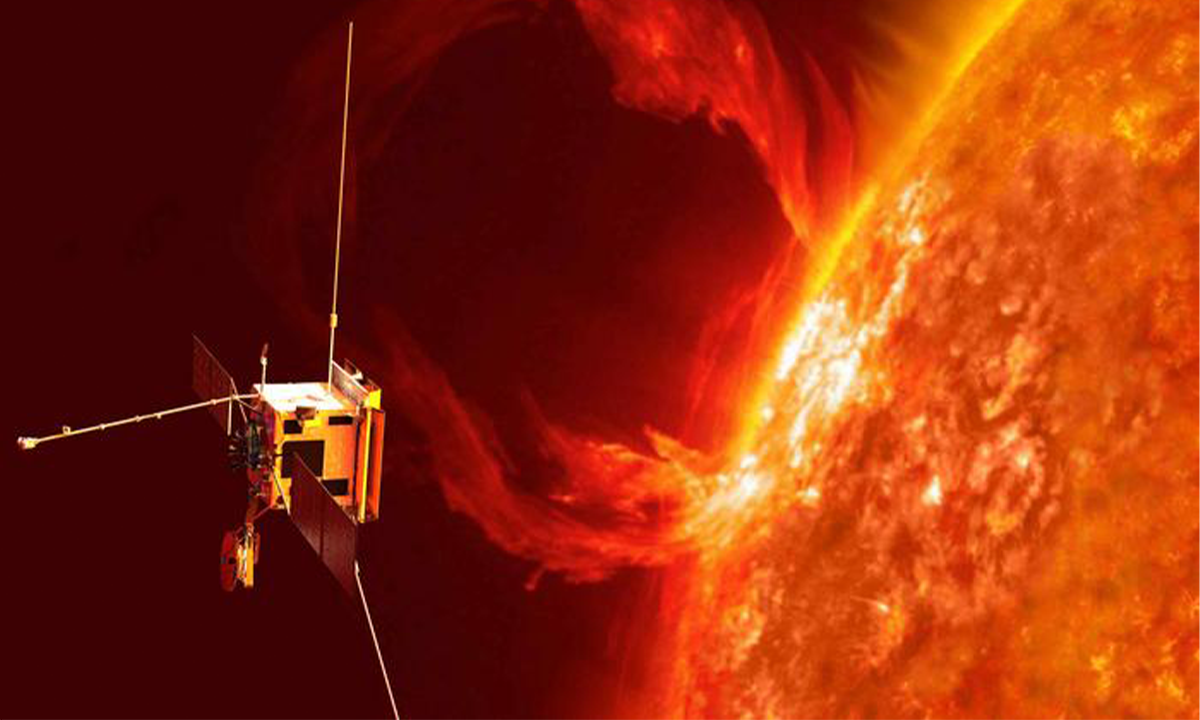
Unfortunately, these flares can be difficult to predict. That’s in part because, rather than just sitting idle at the center of our solar system, the sun rotates on its axis once every 28 days, meaning we can only observe solar storms forming on its surface for two weeks before they spin out of view. Or at least that was the case before the European Space Agency (ESA) launched the Solar Orbiter mission in 2020.
Orbiting the sun every six months, this spacecraft keeps an eye on the far side of the sun while researchers on Earth watch the near side. Recently, Harra and Ioannis Kontogiannis of ETH Zurich collected data from both vantage points, observing a powerful solar storm brewing—the strongest in over 20 years—for an unprecedented 94 days. They published their findings in Astronomy & Astrophysics.
Read more: “The 315-Year-Old Science Experiment”
“This is the longest continuous series of images ever created for a single active region: It’s a milestone in solar physics,” said Kontogiannis. With the Solar Orbiter, the team was able to watch as the magnetic tempest formed, became increasingly complex, flared, and then decayed.
They hope these unprecedented observations will improve the accuracy of solar storm forecasts so that we can better understand—and ultimately better prepare for them—on Earth. While the Solar Orbiter has proved to be indispensable in this mission, scientists still aren’t able to use it to predict how severe solar flares will be, but help is on the way.
“We’re currently developing a new space probe at ESA called Vigil which will be dedicated exclusively to improving our understanding of space weather,” Harra said. That spacecraft is scheduled to launch in 2031.
Enjoying Nautilus? Subscribe to our free newsletter.
Lead image: ESA / AOES