Cyclones, tsunamis, floods, and tornadoes are devastating for humans, animals, plants, and buildings, leaving destruction and often death in their wake. But what we don’t often consider is how such disasters impact microbial communities and what that can mean for the ecosystems they inhabit. As extreme storms, wildfires, and other natural disasters become more common with climate change, how they will disturb the vast, nearly invisible universe of fungi, bacteria, archaea, and other microorganisms in our midst is still largely unknown.
In a paper published in early August, Johns Hopkins University infectious disease researchers Arturo Casadevall and Daniel Smith proposed a new field of study, “disaster microbiology,” to look at the impacts that both natural and human-made calamities have on microbes. Casadevall and Smith adapted the idea from a 2022 colloquium report on climate and climate microbes from the American Society for Microbiology.
Why is “disaster microbiology” needed now?
Smith: Disasters have always happened, so it's always been relevant, but as climate change increases the pace of disasters, the need for a subfield devoted to disaster microbiology becomes more urgent. We need to better understand how microbes are changed by disasters, and then start to implement solutions so that we can mitigate the issues as they arise more frequently.
While researchers have for decades studied how flooding or windstorms can lead to changes in microbial communities that lead to infectious disease, consolidating all of this research under one subfield helps bring everybody to the same table, people from fields like engineering, modeling, microbial ecology, and infectious disease research. Together, we can analyze this data and make a plan for the future to prevent infections.
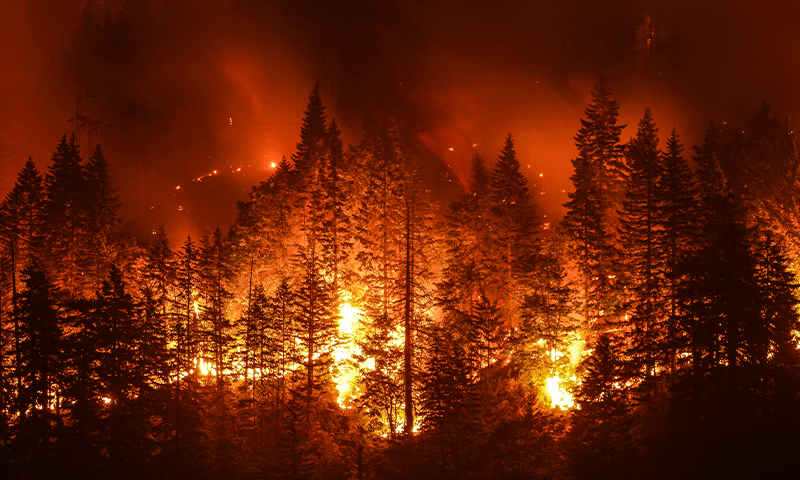
Microbes can be aerosolized by fire and survive in the smoke.
Is infectious disease the most significant concern?
Smith: Well, we are infectious disease experts, so that’s our bias, but animal health and plant health and general ecosystem well-being are also important. Microbes that are beneficial for certain ecosystems could be impacted in detrimental ways.
How does knowing how microbes change following a disaster help us?
Casadevall: You can imagine that if you're going to do bioremediation—the use of microorganisms or other life to break down environmental pollutants—you can't just bioremediate by bringing in the animals and the plants, you've got to bring the microbes. You need to be able to repair those communities.
Do we know anything yet about how the fires in Maui might impact the microbiome there?
Smith: We wouldn’t have data from that yet, but a lot of people study wildfire-associated microbiology both in the soil and wildfire smoke. Microbes can be aerosolized by fire and survive in the smoke that circulates far from the origin point.
How might microbes change the way they relate to mammals as they adapt to climate change and related disasters?
Smith: Microbes evolve more rapidly than mammals because their lifespans are so short. So microbes might quickly adapt to higher temperatures or reduced access to water or fewer nutrients, and those types of adaptations might make them better suited to survive inside of mammals. This is the concern with fungi, for example. They can't currently survive at human body temperature, but if they're driven to adapt to higher temperatures, that might allow them to survive and cause disease within mammals, which have a relatively high body temperature.
What do you hope disaster microbiologists will learn in the next couple of years?
Smith: Better surveillance of emerging pathogens, especially following disasters, to know what microbes are emerging, and could then be spread by the next disaster.
But on a positive note, we might gather some information about bioremediation. In some of these areas, like an oil spill, there's an enrichment of microbes that could help break down the oil. In the 1990s, for example, Geobacter sulfurreducens, also known as the "electric microbe," were discovered in a ditch in Oklahoma that was contaminated with oil. From there, it was found that these bacteria can help bioremediate uranium and heavy metals in groundwater. So it’s possible studying the microbiomes of disasters will help with future bioremediation efforts. 
Lead photo: Christian Roberts-Olsen / Shutterstock