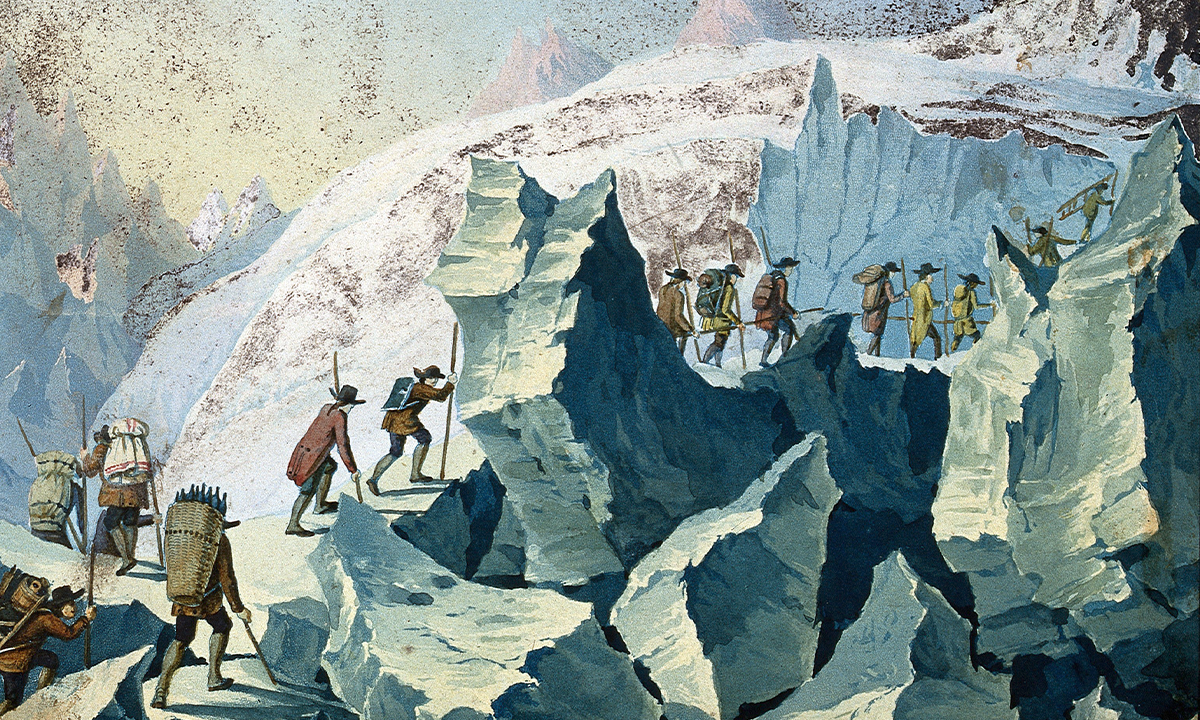
In 1787, Swiss scientist Horace Bénédict de Saussure became among the first people to reach the top of Mont Blanc, the tallest peak in Western Europe. But he didn’t ascend nearly 16,000 feet merely to marvel at the panoramic views of the snowy Alps—he came equipped with scientific equipment designed for this daring climb. Among his tools was a cyanometer, which de Saussure had invented to gauge the sky’s precise blue hue.
De Saussure, who was born on this day in 1740, grew captivated by the geology and plants of the Alps. In 1759, he graduated from Geneva College, and a few years later he became a professor of natural philosophy at just 22 years old.
He was one of the first researchers to suggest that naturalists should collect detailed measurements in the field, rather than solely gathering specimens. This fascination with the untapped data surrounding him led him to a strange invention.
As he made mountain expeditions, de Saussure noticed that the sky took on a more intense blue color at higher altitudes. He developed an instrument to measure this phenomenon: the cyanometer, a disk with pieces of paper dyed various shades of blue. In August 1787, de Saussure started his journey up Mont Blanc with the help of 19 porters and guide Jacques Balmat—who had become the first person to reach this peak a year earlier.
At the summit, the vibrant blue he observed proved nearly too blue for the cyanometer. He also measured the atmospheric pressure, humidity, and static electricity at the peak, among other data. de Saussure attributed these varying blues seen on treks to the air’s humidity and transparency at different altitudes.
Read more: “The Stories Rocks Tell Us”
A year later, he held up the cyanometer to the sky on the Col du Géant mountain pass, at around 11,000 feet above sea level, while his son did the same in the valley in Chamonix below, along with a friend in Geneva. To de Saussure, these measurements offered solid evidence of his hypothesis. This was “the dawn of coordinated, quantitative meteorology,” wrote chemist Andrea Sella for Chemistry World in 2010.
It took around a century for scientists to truly grasp the mechanism behind these contrasting blue hues: Experiments by Irish physicist and mountaineer John Tyndall in the 1860s revealed that sunlight scatters particles in the upper atmosphere, giving the sky its color. And we know today that, in higher elevations, there are fewer molecules to kick around light. This causes the darker shades glimpsed by de Saussure as he climbed, and also explains why space is pitch-black.
While the cyanometer fell out of fashion, de Saussure invented other instruments still used by scientists today. These include a type of hygrometer, which measures humidity with a human hair. When relative humidity shifts, organic substances like hair expand and contract. He also created what’s thought to be the first solar cooker, and helped popularize the term geology over its predecessor, geognosy—the newer iteration certainly has a much better ring to it. 
Enjoying Nautilus? Subscribe to our free newsletter.
Lead image: Wellcome Collection / Wikimedia Commons