Back in March, the Einstein Probe telescope in low-Earth orbit captured a cosmic event of such potential significance that it had astronomers around the world scrambling to get a better look.
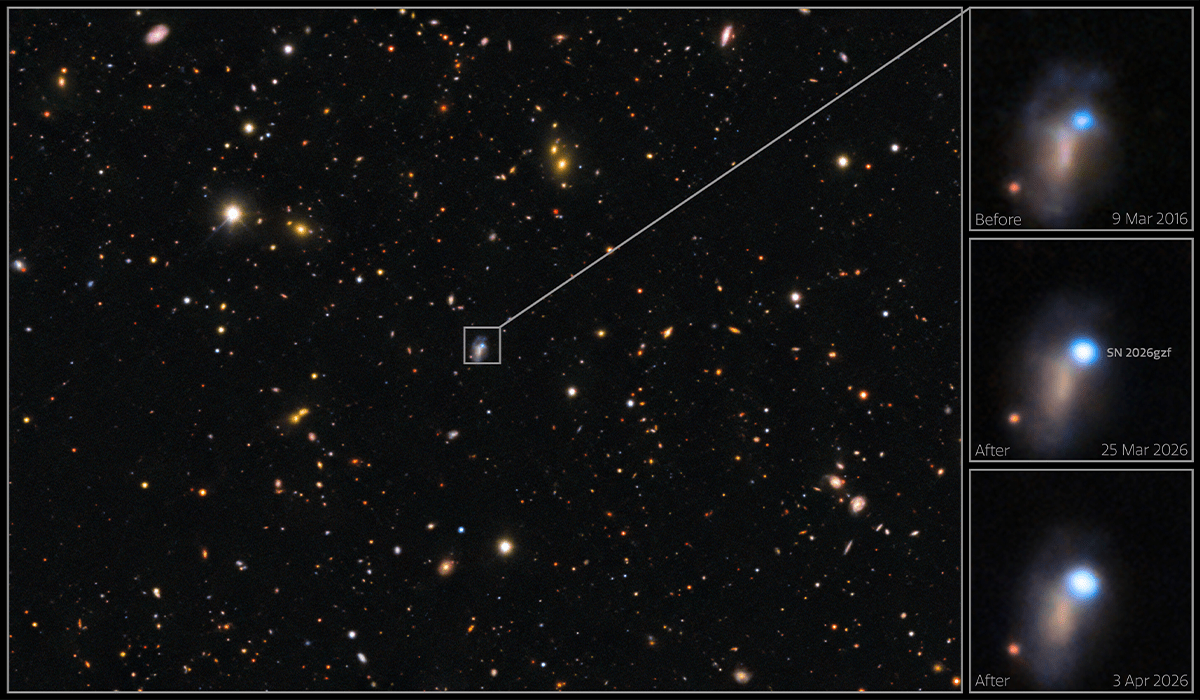
That event was a brief flash of X-rays some 500 million light-years away, a flash given the designation EP260321a. It was what’s known as a “shock breakout”: the first moment that a massive dying star reveals itself, as its collapsing core shoots a blast of X-rays and ultraviolet light from trapped energy breaking through the star’s surface.
Experts responded within an hour of the first detection, and eventually more than a dozen telescopes were trained on the spot in the sky where the ongoing supernova explosion—now dubbed SN 2026gzf—was marking the end of the star’s life.
Read more: “The Supernova That Sparked the Original Scientific Revolution”
The explosion of stellar material was classed as a Type Ic-BL supernova, a particularly violent event where matter is pushed out at extremely high speeds.
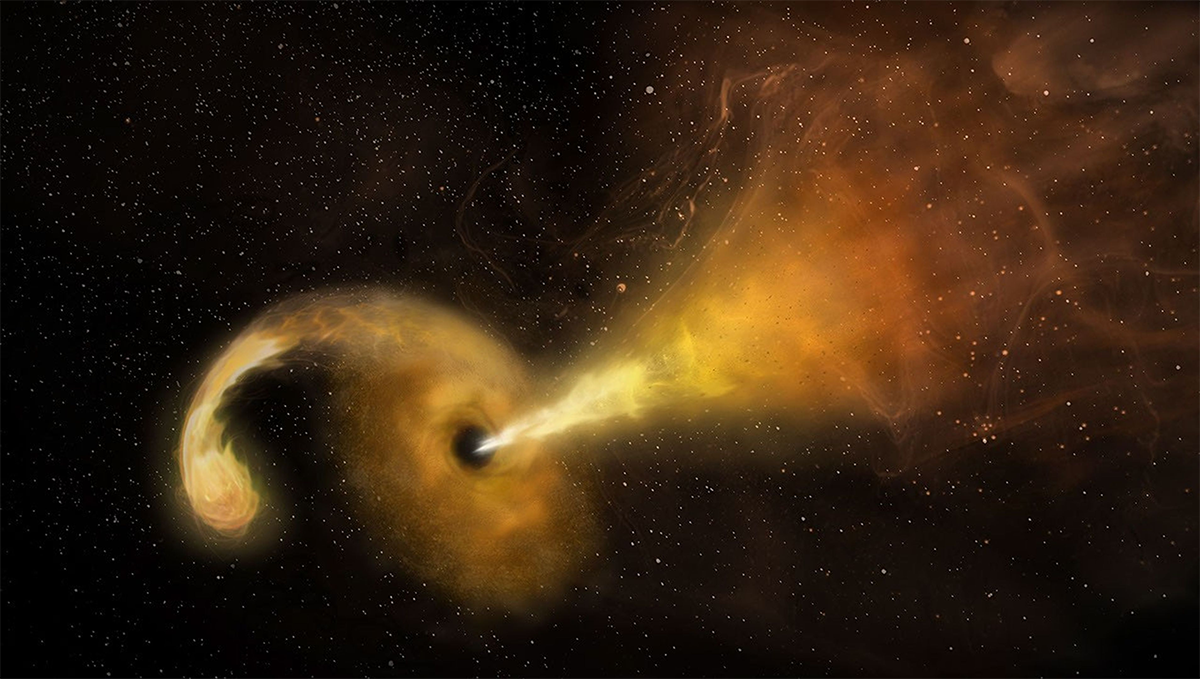
There were two plot twists here, though. First, given the size of the dying star, some 20 times the mass of our own sun, the shock breakout was unusually faint (albeit bright enough to be picked up). And second, astronomers expected to see a narrow blast of plasma bursting from the supernova at close to the speed of light, creating a gamma-ray burst detectable by our telescope network. And yet, no such plasma jet ever appeared.
“One possibility is that the jet was ‘choked,’ either by the surface of the star or by circumstellar material surrounding the star,” astronomer Greg Zeimann, a member of the team at the McDonald Observatory in Texas that was trained on the activity of SN 2026gzf, explained in a statement.
Follow-up readings established that the star was irregular even before the supernova stage, ejecting all of its hydrogen and helium in an unusual way.
The discovery and recording of SN 2026gzf provide important new insights into how different types of supernova progress—and how the biggest and most violent ones don’t always end in expected ways. Findings from the research have been published in two papers in The Astrophysical Journal Letters.
We don’t get to see these shock breakouts very often; the last confirmed sighting was in 2008. “These events have historically been difficult to detect because they’re brief and because this part of the transient sky has lacked sensitive, wide-field monitoring,” said Zeimann.
But now, with the vast space-scanning capabilities of the Einstein Probe at our disposal, we’ll be able to identify them more regularly—and these tiny dots of light hundreds of millions of light-years away will start to feel a whole lot closer. 
Enjoying Nautilus? Subscribe to our free newsletter.
Lead image: CTIO/NOIRLab/DOE/NSF/AURA