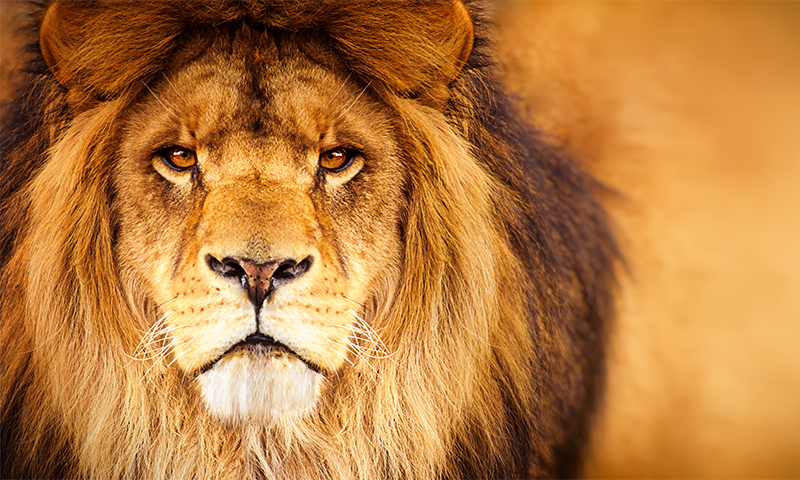
The regal African lion is a species in dramatic decline. Biologists estimate that populations of Panthera leo have fallen by almost three quarters over the past 50 years, leaving just 23,000 mature lions on the continent. While habitat loss and vanishing prey populations are the biggest hazards to the species, illegal poaching remains a major threat.
The animals are killed for their body parts—claws, teeth, and bones—which are illegally traded within Africa or exported to destinations in Asia, where they are turned into jewelry or used in traditional medicines. Retaliatory killings, often occurring after conflict with livestock, add further stock to this trade with body parts removed in the aftermath of almost half of conflict-driven deaths. But as the parts are circulated across borders, it becomes difficult for wildlife crime investigators to determine their geographic origins, complicating efforts to catch the poachers and stop these crimes.
New software called the Lion Localizer may be able to help. It’s a database of lion mitochondrial DNA representing 146 locations across Africa and India where lion DNA sequences have been collected and cataloged. Biologists can use the tool to anonymously query DNA sequences extracted from confiscated lion parts to see if they can identify a match.
“If you put in a sequence and a lion head icon pops up on the map,” you have an exact DNA match, says Alfred Roca, a genetics professor at the University of Illinois Urbana-Champaign and the principal investigator on the Lion Localizer project. You know where your dead lion roamed. More often, you will get a red pin on the map, which tells you the lion likely came from a particular region of an individual country, such as Masai Mara in Kenya. Or you may get a black pin, which tells you only the country where your lion may have lived.
Penalties for poaching and trafficking wildlife have stiffened in many African countries over recent years.
The scientists who developed the tool at University of Illinois at Urbana-Champaign chose to focus on mitochondrial DNA. For one, it’s more plentiful than nuclear DNA, which means large amounts of it are easily gathered from lion bones or other parts that have been seized by law enforcement. Secondly, mitochondrial DNA is transmitted by the maternal lineage—which is convenient since females tend to stay put, while males typically stray farther. That means mitochondrial DNA is more closely associated with a single geographical location.
“It’s easier to deal with mitochondrial DNA because you get a lot more copies and it’s not as widely dispersed as other genetic markers. It can give you a better idea of where the lion is from,” says Roca. Knowing provenance is particularly critical in regions like West Africa, where lion population numbers are dangerously low.
Penalties for poaching and trafficking wildlife have stiffened in many African countries over recent years, but this presents a new set of challenges. Offenders used to plead guilty when the consequences were little more than a modest fine. Now, lengthy jail times and large fines mean poachers are more likely to go to court where the burden of proof lies with the prosecution.
“It’s mainly about forensic intelligence and understanding where things come from,” says Rob Ogden, director of TRACE Wildlife Forensics Network, a United Kingdom-based nonprofit that aims to apply forensic science to wildlife law enforcement and a partner in the Lion Localizer project. “In some cases, the penalties are higher if the part comes from a nationally poached animal,” says Ogden.
Lion Localizer isn’t a tracker. It can’t follow animals on the move. But it’s a valuable intelligence tool in the fight against wildlife crime—one that is open-source, anonymous, and free to use. 
Lead image: The Len / Shutterstock