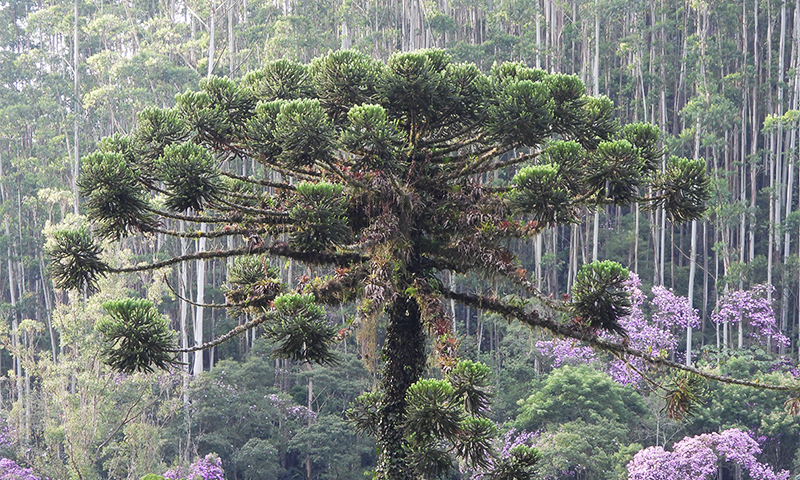
When Portuguese colonizers landed on the shores of South America 500 years ago, a dense forest stretched across the southeastern coast of what is now Brazil into parts of present-day Paraguay and Argentina. The Atlantic Forest, as it is now known, covered an area twice the size of Texas and was the source of one of the colonizers’ chief exports: the red dye of the Brazilwood tree, which gave Brazil its name.
Today, more than one third of South America’s population live within the borders of this forest, and four out of every five trees there have been felled. The decimation is so extensive, according to a new study in Science, that a majority of the tree species in the forest now face extinction—far more than previously thought. The authors say their findings have profound implications for tropical forests on other continents.
“When you put it into numbers, you kind of freak out about it,” says Renato Augusto Ferreira de Lima, the study’s lead author. To evaluate the extinction risks of the nearly 5,000 tree species found throughout what remains of the Atlantic Forest, including over 1,000 species that had never been assessed before, he and his co-authors compiled field data and scrubbed herbarium records and forest inventories.
They found that 65 percent of the trees in the forest face extinction. The picture is most dire for endemic species, those found in the Atlantic Forest and nowhere else: About 82 percent of these trees are threatened, including many species emblematic to the region, the scientists found. For example, Brazilwood has experienced an 84 percent drop in its population size over the past three generations. Wild populations of yerba mate have been halved.
When you put it into numbers, you kind of freak out about it.
Previous assessments of trees in the Atlantic Forest by the International Union for Conservation of Nature and its partners used the reduced geographic ranges of trees as the primary metric to estimate shifts in population sizes and determine their protection status. Ferreira de Lima says this approach can significantly underestimate extinction risks.
Unsurprisingly, the scientists found that protected areas in the Atlantic Forest had fewer threatened species. “This highlights that threatened species are concentrated where habitat loss and fragmentation are greater,” they write.
Ferreira de Lima and his colleagues say their estimates of the extinction risks in the Atlantic Forest are probably conservative, given how fragmented the forest is and when deforestation occurred. Most trees were felled in the past 50 to 70 years, which, for many species, falls within the past two to three generations. “The effects of past habitat loss, fragmentation, and selective logging on these long-lived species may not have had enough time to fully express themselves, which suggests an extinction debt yet to be paid in the coming decades,” they write.
Many other tropical forests around the world lack the wealth of data available on the Atlantic Forest to conduct similar assessments, so Ferreira de Lima’s team used their findings to extrapolate preliminary projections for 18 other tropical regions around the world. Based on observations in both the Atlantic Forest and the Amazon, they estimate that roughly 20,000 to 25,000 tree species are threatened with extinction globally in tropical forests alone—a figure that, on the low end, equates to more than a third of all species of trees on the planet.
What that could mean for the planet is unclear—but it is not good. Trees play important ecosystem roles including carbon sequestration, water filtration, and the provision of food and shelter for other plants and animals. “Lots of animals depend on trees for nesting, feeding, and also for protection,” says Ferreira de Lima, “and some of those interactions are really species specific.”
The loss of trees could unravel a delicate web of life in these tropical forests, which contain the vast majority of biodiversity on Earth.