If humanity is going to have any kind of future on Mars, we’re going to need water. The good news is that Mars has plenty of it. The bad news is that it’s frozen—and much of it is buried under layers of debris.
We know it’s there thanks to the Mars Reconnaissance Orbiter, which celebrated its 20th anniversary in March. Unfortunately, the orbiter is too far away from the surface to determine just how deep this ice is buried. Now, new research published in the Journal of Geophysical Research: Planets is refining our detection capabilities by using drones right here on Earth.
“If you want to make decisions about where to drill on Mars, you need to know if the ice you’re trying to find is under one meter of debris or 10,” study author Roberto Aguilar of the University of Arizona said in a statement. “That’s the kind of information a drone-based system could provide.”
To test these systems, Aguilar and a team of planetary scientists trekked out to two remote glaciers in Alaska and Wyoming buried under loose rock. Using drones equipped with ground-penetrating radar they were able to map the subsurface ice formations and then check their work by drilling and excavating the glaciers.
Read more: “Hear the Wind on Mars”
Mapping glaciers on Earth also allowed the team to develop best practices for doing the same on Mars. “For instance, we learned at what altitude and speed the drone should fly, as well as the importance of flying in the direction of the glacier’s flow, and how to make sure the radar was properly aligned to detect the ice,” Aguilar said.
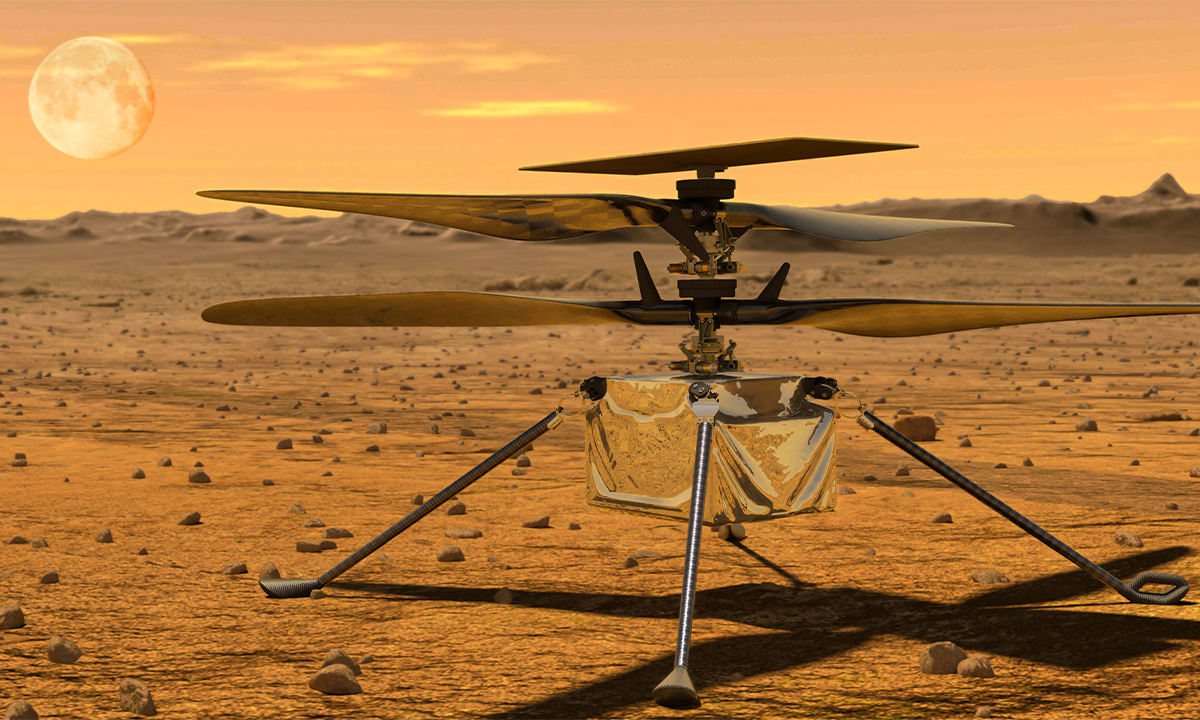
Still, flying drones on Mars comes with plenty of challenges. The red planet’s atmosphere is incredibly thin, which means martian drones will have to be lighter and more powerful than their terrestrial counterparts in order to achieve liftoff. Thankfully, we’ve done it before with NASA’s Ingenuity drone that launched with the Mars rover Perseverance in 2020. Meticulously constructed using mostly off-the-shelf components, this 4-pound marvel made 72 flights before being grounded by a damaged rotor.
The researchers say the ground-penetrating radar is light enough to fit the payload specifications for the proposed Mars Scientific Helicopter. And, while flight is more difficult on Mars, detecting martian glaciers could be easier. According to the team, water on our planet can interfere with the radar’s electromagnetic waves, but the red planet’s parched soil should be easier to “see” through. 
Enjoying Nautilus? Subscribe to our free newsletter.
Lead image: Fukume / Adobe Stock