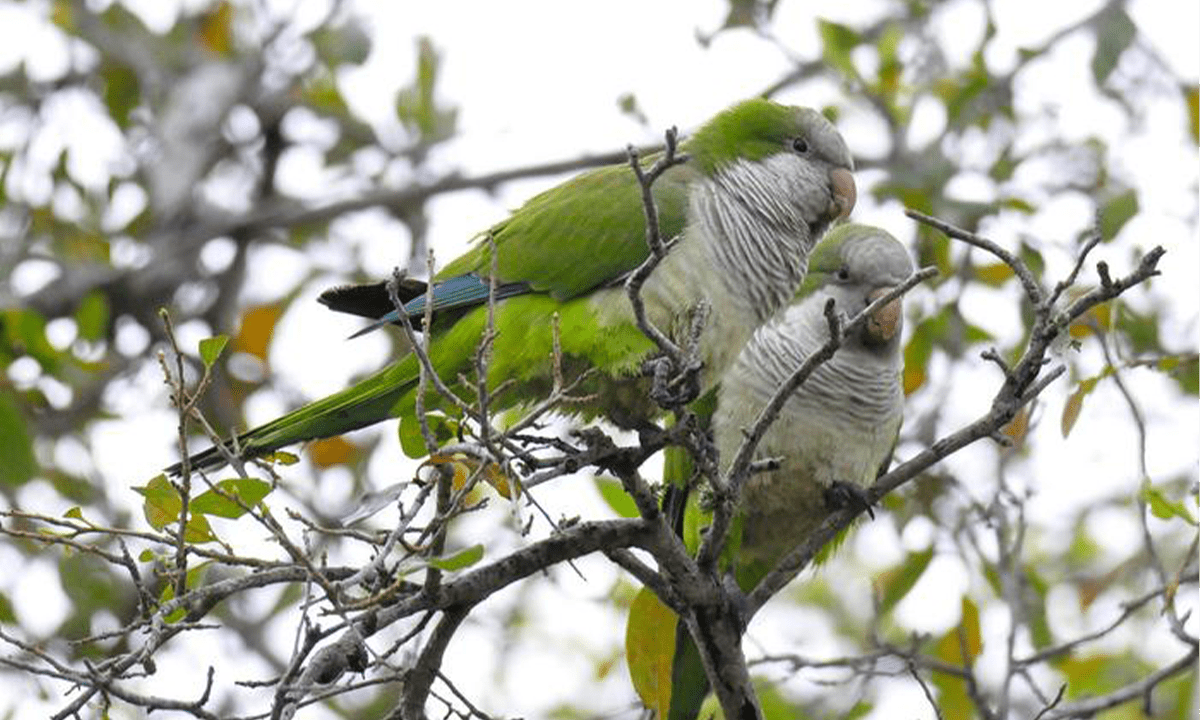
Making new friends can be awkward. Whether you’re a student at a new school, an empty nester looking to get out more, or a monk parakeet, nobody wants to embarrass themselves or get mixed up with a bully. Birds of a feather may stick together, but they have to make friends with one another first, and that means testing the waters.
That’s what researchers at the University of Cincinnati learned when they played matchmaker for a group of monk parakeets. These noisy social birds known for building large communal nests have timeworn strategies for evaluating potential new bird buddies: They approach gradually, checking strangers out, tiptoeing into increasingly risky interactions. Some birds don’t take well to attention from newcomers and can become aggressive, which can lead to injuries. Better to go slow than lose a feather, or worse.
“There can be a lot of benefits to being social, but these friendships have to start somewhere,” said Claire O’Connell, the study’s lead author and a Ph.D. student at the University of Cincinnati, in a statement. O’Connell and her colleagues published their results in the journal Biology Letters.
The scientists threw together wild-caught parakeets, some friends and some strangers, in aviaries and watched the social drama unfold. They tracked how close they got to one another and which birds ended up grooming one another, touching beaks, or sharing food. They then analyzed details of the 179 different relationships that formed, using computational and statistical modeling to identify patterns that emerged.
Read more: “How Many Real Friends Can You Have at Once?”
What they noticed is that the parakeets tested the waters with one another gradually. They were more cautious with strangers than with birds they knew, and started out sharing space, keeping a polite distance, feeling out the vibe. If nobody got aggressive, they would get friendlier, perching shoulder to shoulder, touching beaks or preening one another. Once they established safety, they progressed to sacrifice and even commitment: sharing food or even escalating to romance.
“What’s really fascinating about testing the waters is how intuitive it feels,” O’Connell said. The results echo comparable findings from a 2020 study of vampire bats that showed relationships progressed in predictable ways, from space sharing to social grooming to food sharing to partnership.
“I can definitely relate! I started observing the parakeets shortly before I moved to Cincinnati to start graduate school,” added O’Connell. “I was excited but also a little nervous about making new friends. At the same time, I was literally watching the parakeets make new friends themselves, although some did better than others. I started realizing there may be something I could learn from the parakeets.”
Maybe we all can. 
Enjoying Nautilus? Subscribe to our free newsletter.
Lead image: Michael Miller