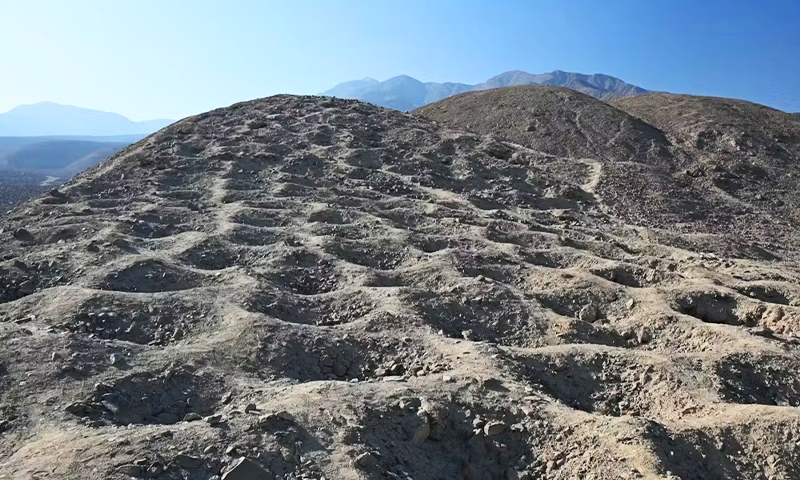
In southern Peru, Monte Sierpe or “serpent mountain” is dotted with more than 5,000 elusive, meticulously arranged holes that are lined up for nearly a mile. More than six centuries ago, these pockmarks might have served as a tax spreadsheet of sorts for the Inca Empire, according to new findings published in the journal Antiquity.
These mysterious mountain dots were captured in aerial photographs by National Geographic explorer Robert Shippee, which were published in 1933. Since then, they have captivated the public and researchers, who have offered up wide-ranging explanations behind their origins: capturing fog, collecting water, mining, gardening, or even aliens, among other theories. Now, detailed analysis of this site, also known as the Band of Holes, has revealed intriguing patterns that point to intricate record-keeping, an international team of researchers argues.
The Inca people appear to have used this feature continuously between 1400 and 1532, and it sits near the intersection of once-bustling pre-Hispanic trade routes. It’s also located between two Inca administrative centers: Tambo Colorado and Lima La Vieja. This suggests a link to trade and government affairs, the new paper’s authors say.
When taking a closer look at Monte Sierpe via drone imagery, they noticed that the holes are grouped into at least 60 sections. The researchers also spotted precise numerical patterns in these sections, such as alternating repetition in the number of holes per row.
This reminded them of another Inca invention: khipus, Inca accounting tools made of knotted string that were used to tally information including census data and tribute taxes. Researchers have found more than 1,000 surviving khipus, and one discovered near Monte Sierpe shows similar organization of data into 80 groups of cords.
“The regularity of these squares is comparable to the numerical patterns at Monte Sierpe, suggesting a potentially similar purpose: the counting and sorting of different goods,” the paper notes.
These thousands of holes may have been turned into a spreadsheet after the Inca Empire took over the area in the 15th century, which was previously ruled by the powerful and sophisticated Chincha Kingdom. As in other areas, the Inca introduced a tax system that demanded labor or tribute, such as produce.
At Monte Sierpe, each section of holes may have been “linked to a particular social group for the payment of tax and the redistribution of commodities,” the new paper suggests. The range of numerical patterns they observed might be linked to local khipus and 16th-century tribute lists in the Andes, and the size of taxpaying populations may have varied among specific towns and villages.
But this striking site might not have always worked as a dynamic tax document. Scientists also studied sediment samples from holes throughout the Monte Sierpe, and they discovered ancient pollen from plants such as willow, which was traditionally incorporated into baskets and mats, and from corn, a staple crop in the Andes. Before the Inca Empire took power in the region, the Chincha Kingdom might have used these holes to maintain a standardized barter system. “Depositing goods in the holes could have been a way of publicly displaying information about the quantity of goods available as well as the quantity of goods required for a fair exchange,” study authors Jacob Bongers and Charles Stanish wrote for The Conversation. A specific number of holes filled with corn might have been equal to a different number of holes filled with cotton, for example.
The authors say these theories are “tentative,” but it “brings us closer to unravelling the purpose behind one of the most enigmatic archaeological sites in the Andes.” 
Enjoying Nautilus? Subscribe to our free newsletter.
Lead photo by Charles Stanish