Archaeologists working at Gomolava in northern Serbia recently uncovered a 2,800-year-old mass grave containing the remains of 77 people. As they sifted through the bone and debris, a chilling story began to unfold, which they detailed in a study published in Nature Human Behavior.
The people buried there all came to violent ends, killed by bludgeoning or stabbing, and almost all were women and children. Analysis of the bones revealed 40 of the victims were children between the ages of 1 and 12, 11 were adolescents, and 24 were adults, almost all of whom were women.
Surprisingly, genetic analysis revealed they weren’t related to one another, even distantly, an uncommon finding for mass graves. Additionally, isotopes in their teeth indicated they had dissimilar childhood diets, suggesting that they were from different settlements altogether, and most likely captured.
“When we encounter mass graves from prehistory with this kind of demographic, we might expect they were families from a village that was attacked,” co-author Barry Molloy of University College Dublin said in a statement. “Gomolava genuinely took us by surprise when our genetic analysis showed the majority of people studied were not only unrelated, not even their great-great-grandparents were. This was highly unusual for a prehistoric mass grave and not what we expect to find if they had all lived together in a village.”
Read more: “The Curious Case of the Bog Bodies”
Because the young victims were slaughtered instead of taken as slaves, researchers believe their killing was meant as a macabre warning to others.
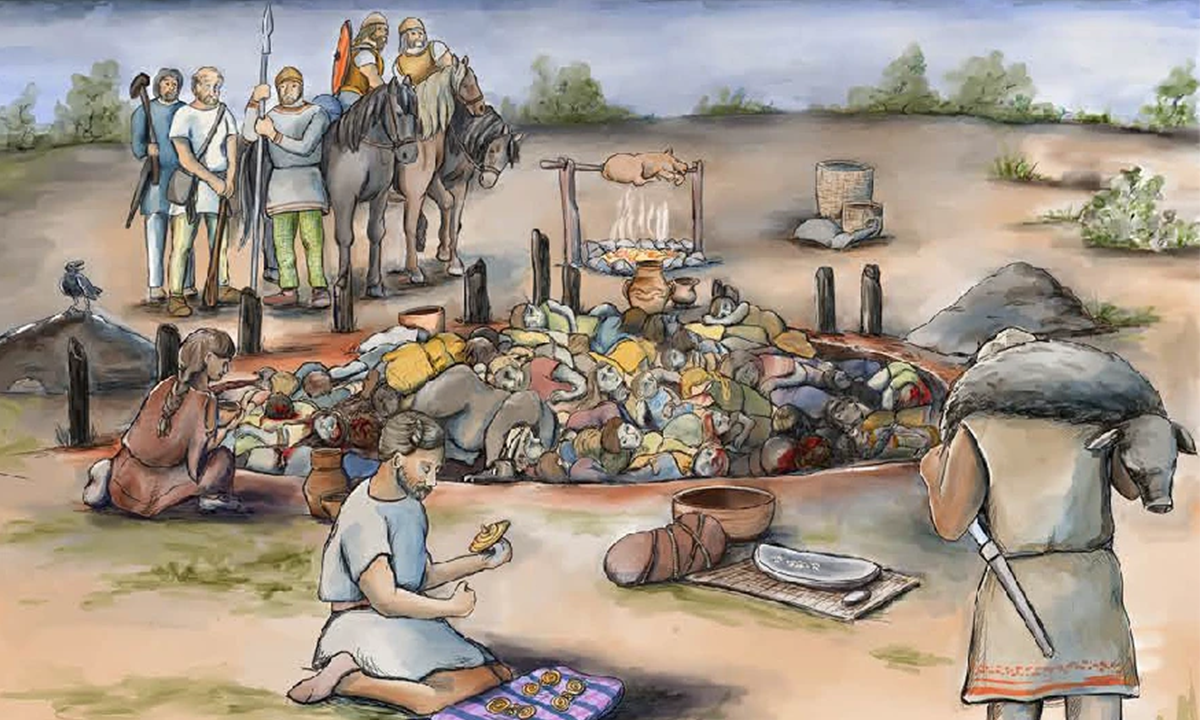
While the find paints a vivid picture of the brutal violence that characterized Iron Age life, it shows another side of humanity as well. The victims appear to have been mourned. They were buried with personal effects including bronze jewelry and ceramic pottery, alongside a butchered calf with an offering of burnt seeds sprinkled atop.
“The victims at Gomolava were hastily buried in a disused semi-subterranean house, but uniquely, not only had the bodies not been looted of their valuables, offerings were made in what must have been a respectful ritual,” Molloy said.
The team believes the massacre occurred around the same time people were seeking to reoccupy abandoned Bronze Age settlements.
“Our team has been tracing the Bronze Age collapse and its aftermath in Europe. What we found at Gomolava tells us that as things recovered in this area moving into the Iron Age, reasserting control over landscapes could include widespread and extremely violent episodes between competing groups,” Molloy said.
Altogether, the find represents a grisly chapter in the evolution of large-scale violence in European protohistory. 
Enjoying Nautilus? Subscribe to our free newsletter.
Lead image: Nature Human Behaviour (Nat Hum Behav)