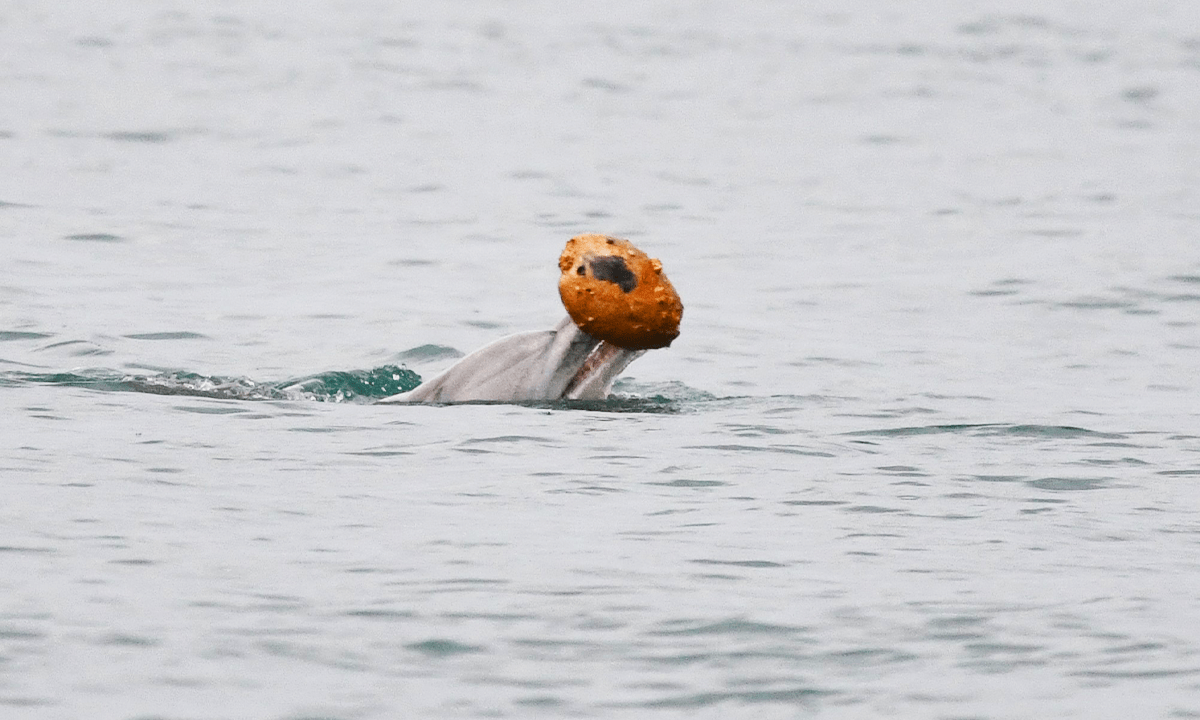
Fifteen years ago, a note in the journal Marine Mammal Science commented on an odd behavior of dolphins in Western Australia. These Indo-Pacific bottlenose dolphins (Tursiops sp.) were seen lifting big conch shells from the water by sticking their noses into the openings. The purpose of this “shelling” was revealed when dolphins shook the shell to drain water out of it and eat a fish that had been trapped inside. Since then, multiple bouts of shelling have been observed in dolphins in these waters.
Now, a new study in Marine Mammal Science reports shelling in another dolphin population, this time in Eastern Australia. It’s based on footage of two instances of shelling captured by the researchers, along with reports from a dolphin tour company. “We were on a research boat … when we spotted a dolphin raising something large out of the water,” said lead study author Alexis Levengood, a marine mammal biologist at the University of the Sunshine Coast, in a press release. “I started screaming because I know what shelling looks like.”
Handling the conch shell requires specialized skills that must be somehow taught and learned by dolphins. They’ve got to find the shell, get a fish to go inside it (if a fish isn’t in there already), and manipulate the shell to keep the fish inside as they bring it to the surface.
Read more: “Do Whales Have Culture?”
A prior study had ruled out parent-offspring learning; instead, the authors suggested horizontal learning between dolphin peers. The new research at the Great Sandy Marine Park in Queensland, however, found otherwise. A mother dolphin surfaced several times with a big bailer shell on her nose. After she dropped it, her calf surfaced with the shell on its nose, holding it like the mother and then slapping it on the water surface.
It wasn’t clear whether either dolphin succeeded in eating any fish trapped inside, but these parallel behaviors “are suggestive of (maternal) social transmission between mother and offspring through observational learning,” wrote the study authors.
Either way, shelling is certainly something dolphins have a nose for. 
Enjoying Nautilus? Subscribe to our free newsletter.
Lead image: UniSC