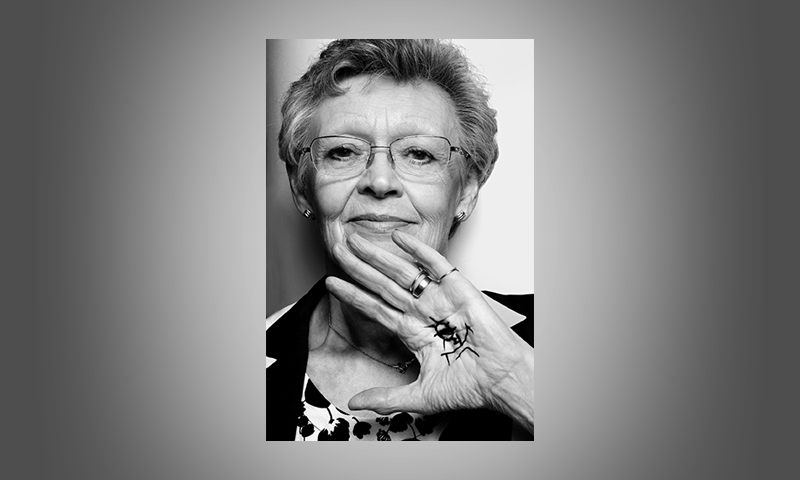
Francoise Barre-Sinoussi was so engrossed in her work at the Pasteur Institute on HIV in the 1980s that she almost missed her own wedding. She went on to win a Nobel Prize in Physiology or Medicine, in 2008, for identifying HIV as the cause of AIDS.
Barre-Sinoussi had to overcome intense sexism, as well as disbelief from other scientists about the validity of her findings. The suffering of AIDS patients, many of whom became her friends, left her with debilitating depression. Extreme patience and doubt, she says, were essential to her ability to succeed.
Barre-Sinoussi is currently honorary president of the Pasteur Network, an international nonprofit research foundation headquartered in France. I spoke with her about her Nobel Prize-winning discovery, her connection to AIDS patients, the future of HIV medicine, and the role of doubt in science.
You were so involved with your work that you nearly missed your own wedding. Tell me the story.
I was here at the Pasteur Institute. It was around 11 a.m. when my then-fiancé called me and said, “You know, the family’s all here because we’re supposed to be getting married today.” I told him, “Oh, my God, it’s already 11! I’m coming!” He wasn’t surprised at all. I hadn’t forgotten that we were getting married; I simply lost track of time.
What was the moment of discovering the HIV virus like for you?
It wasn’t one moment. It never is in science. It’s several successive moments that build to a discovery. The first sign that there may have been a virus in the culture came when I detected enzyme activity related to this family of viruses. But there was still a lot of work left to do. Eventually, we looked at the culture under the microscope and saw particles—viral particles the same size as retroviruses. But even then, we didn’t have proof. It was a long process until we could say, “Yes, this virus really is the cause of the disease.” That didn’t occur until 1983, and it was confirmed in 1984.
You faced a lot of prejudice early on in your career, like sexism. What kind of a mindset did it take to overcome obstacles like that?
Motivation is key. So is patience and a willingness to give to others. This was critical for me. If you’re only doing science for your own enjoyment, or for publishing papers and improving your CV, it won’t be as motivating as if you are developing tools for the benefit of patients. For me, my driving force has always been to help patients.
There’s a story about a patient who held your hand. Would you tell it?
That was back in the 1980s. I gave a seminar at San Francisco General Hospital, and afterward one of the clinicians asked me whether I would be willing to see a man dying of AIDS, who wanted to meet me. So, I went to the emergency room. He was in terrible shape. He had some trouble speaking. I could only guess what he was saying by reading his lips. When he said, “Thank you,” I asked, “Why?” He said, “Not for me; for the others.” That I will remember all my life. He died the next day.
When you have this kind of experience, it changes your motivation. You stop doing things for yourself and you try to give people the tools they need to stay alive. Just to be alive.
“If you’re too sure of yourself, you’re not a good scientist.”
You became very depressed in the 1990s. Why?
That was in 1996. It was related to the fact that for more than 10 years, there had been terrible pressure on the scientific and medical communities to do something about HIV and AIDS. It was the first time I had been in direct contact with people who were affected by a disease as I worked on it. I became good friends with some of them, and I watched them die. As a scientist, I knew it would take time to develop a treatment. But as a human being, it was unacceptable to see people as young as 30 or 35 dying under such terrible conditions. I had to go to a hospital and get treatment for the depression. It took me more than a year to fully recover.
What did it take for you to accomplish what you did?
Extreme patience. One of my colleagues who knew I loved cats once said to me, “I wonder if, in another life, you weren’t a feline yourself because you are so patient. You make your observations for months, years. You always have to be absolutely sure before you’re ready to pounce.” I thought that was a good comparison.
Did you ever doubt yourself as a scientist?
You have to. A scientist must always question whether they’re heading in the right direction. It’s like a game. You never know when you’ll win, but you know that you can always lose. For me, that’s what doubt is. If you’re too sure of yourself, you’re not a good scientist.
Now that it’s possible to prevent the spread of HIV, where do things go from here?
This will be an extremely difficult virus to cure. There are wonderful tools in the works right now, like implants that deliver antiretroviral treatment. But it’s not enough. I am a bit worried about the future because we’re starting to see HIV resist treatment in Africa and Asia. I’m worried that resistance will spread. That would be a nightmare. A re-emerging HIV epidemic would be terrible. It would be the worst failure of my life.
Does it ever give you pause to consider the impact you have had on the lives of others?
I wasn’t alone. They don’t call it the HIV/AIDS community for nothing. We’re scientists, activists, representatives of patients, doctors, nurses, all the medical staff. We are countless people who have been fighting for the same objective since 1981. We are all in it together, and we each make up a tiny piece of the puzzle. That’s all I am: a piece of the puzzle. 
Lead photo by Herlinde Koelbl