Sprinkled throughout Earth’s oceans, thousands of underwater microphones record the sounds of the deep for commercial, military, and scientific purposes. This constellation of hydrophones captures a symphony of sound beneath the waves. The mechanized buzzing of ship engines, swooping whale song, the clicks and whoops of a coral reef ecosystem.
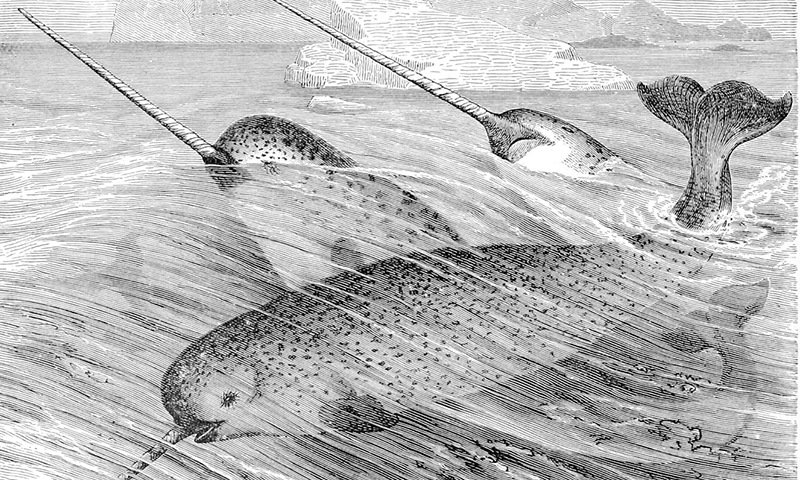
But an array of three hydrophones in the ocean off of Greenland has picked up sounds that surprised the scientists who deployed them—narwhals repeatedly knocking into and rubbing up against the recording equipment.
Between August 2022 and May 2024, researchers recorded oceanic sounds in the Arctic waters of a fjord in northwest Greenland. Amid the marine soundscape, they noted the repeated noises of the narwhals that frequent the area rubbing and hitting—and bouncing echolocation pings off of—their recording equipment, which consisted of hydrophones moored to the bottom of the sea. “Our results suggest that narwhals repeatedly dived to visit the moorings out of playful curiosity or, more likely, due to confusion with potential prey,” Evgeny A. Podolskiy, a researcher at Hokkaido University’s Arctic Research Center and a co-author of a paper reporting the findings in Communications Biology, said in a statement.
Podolskiy and his collaborators counted 247 such incidents over the recording period, and reckoned that narwhals may have been confusing the recording devices with cod or other seafood that makes up their diet. Many of the interactions between narwhals and the recording gear were preceded by the marine mammals’ foraging buzz, an echolocation sound used to locate prey in the water.
Read more: “What Oceanographers Can Learn From Their Animal Colleagues”
Those rubbing sounds, though, may have resulted from different behavior. Marine mammals are known to rub up against rocks when molting, but no such behavior has ever been observed in narwhals. And the gear they were caught rubbing against was relatively deep in the water—from about 620 to 1,300 feet down—a dive that even for a narwhal takes some energy.
Insights from the Indigenous people who collaborated with the researchers on the project suggest that the curious cetaceans may have been merely playing when they rubbed up against the recording devices. “Inughuit hunters were not surprised by the discovered interaction: They are familiar with narwhal entanglement in unattended gear,” Podolskiy said. “They also believe that narwhals like to play and are told so by their parents, and joked that narwhals might scratch their backs, like cats.”
While the catlikeness of narwhals remains an open question, the findings do suggest that recording underwater noises might not be such a passive exercise afterall. The presence of foreign objects may indeed influence the behavior of the very animals the equipment seeks to record. Just ask a playful narwhal. 
Enjoying Nautilus? Subscribe to our free newsletter.
Lead image: Lydekker, R. The Royal Natural History / Wikimedia