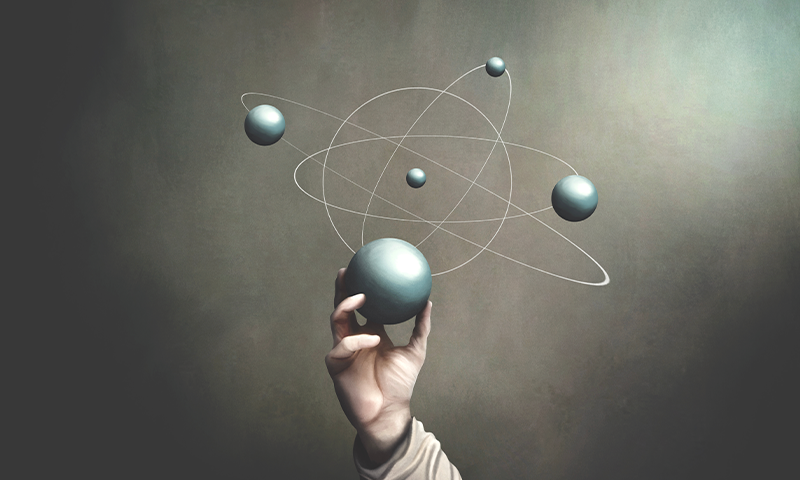
When he was a little kid, growing up in Memphis, Tennessee, Alan Lightman realized he was a materialist. Not in the sense of loving “cars and nice clothes,” the acclaimed physicist and author wrote recently in Nautilus, “but in the literal sense of the word: the belief that everything is made out of atoms and molecules, and nothing more.”
Reading a science magazine one day, he came across a curious fact, that the time for a pendulum to complete a swing back and forth, called a period, is proportional to the square root of the length of the pendulum. If you quadruple the length of the pendulum, the period doubles. The young Lightman had the gumption to test it out for himself, making pendulums short and long using a fishing weight as a bob at the end of a string. Timing their periods with a stopwatch, he found, “lo and behold, that the law was true.” He could predict the periods of pendulums before he built them. “That led me to the view that the world is an orderly place—logical, quantitative,” he said. “There are no ethereal or supernatural forces governing the behavior of things.”
Yet Lightman, a professor of the practice of the humanities at MIT, embraces spirituality—albeit as a consequence of evolution. By that he means, “feeling part of something larger than yourself, or a connection to nature and to the stars, the appreciation of beauty, the experience of wonder and awe,” he said. “If you got separated from the group, if you’re out on your own, for some reason, it was a quick death. And so I think that this need for cooperation, for being part of a larger group, was built into our DNA.”
In a recent conversation we discussed, among other things, what he calls the “creative transcendent.” It’s an aspect of spirituality that he’s experienced across his scientific and literary career. He’s written eight novels, including Einstein’s Dreams, an international bestseller that’s been translated into 30 languages and adapted into plays and musicals. And along with a number of collections of essays and fables, he’s also penned around a dozen non-fiction books, which include In Praise of Wasting Time and, most recently, The Transcendent Brain: Spirituality in the Age of Science.
I asked Lightman to describe a creatively transcendent moment from his life. He was writing a novel, on his third draft or so, and had a character that seemed hollow, “just would not come to life,” he said. “I just didn’t understand her. She didn’t seem real to me. Her dialogue didn’t seem right. Then when I was in the shower, I suddenly heard her say something. It was a line that was so true. It brought her to life. It made me understand her. I don’t know where that line came from. I’m sure it was somewhere in my subconscious mind. From then on, I was able to rewrite her, and it made the whole novel.”
Lightman also explained why he’s fond of the 18th-century philosopher and theologian Moses Mendelssohn. Mendelssohn had a saying Lightman loves, that God commits as few miracles as possible. Mendelssohn’s “a person who wants to believe in the scientific worldview,” Lightman said, “wants to believe that nature is orderly and obeys rules and laws, but also is very spiritual, and believes in the soul and an afterlife.”
Despite being a materialist, Lightman doesn’t consider himself an atheist. Following Einstein, Lightman thinks our minds aren’t big enough to contemplate whether God exists. “Einstein believed that human beings are like children who have gone into a large library. We see a lot of books on the shelves, written in various languages, and we don’t understand all those languages,” Lightman said. “But we think that somehow they got there. That’s his agnostic view, and I feel that I can’t do better than Einstein. The reason why I’m not an atheist is because I don’t like absolutes of any kind.” Watch below.
Lead image: fran_kie / Shutterstock