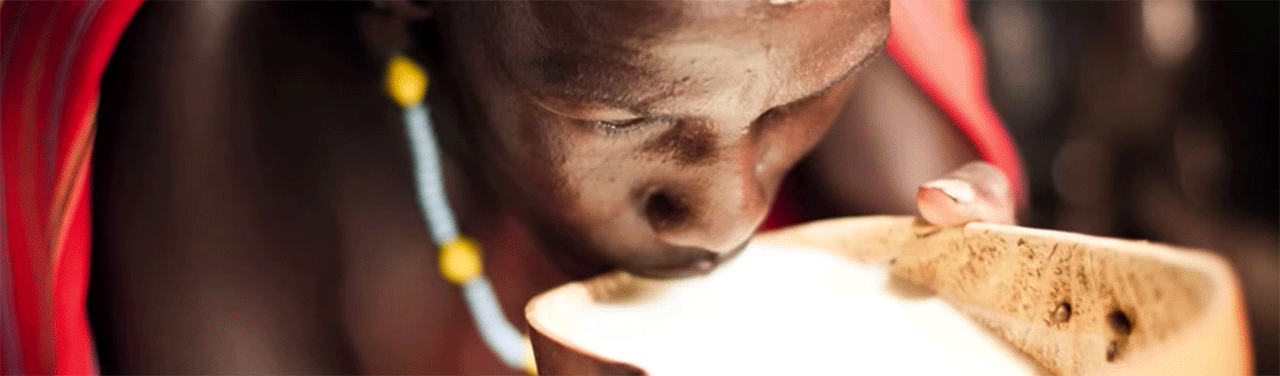
Most people will remember the clever Got Milk ads, which slapped milk mustaches on celebrities in an effort to get Americans drinking dairy. Milk is sold as something healthy and wholesome—after all, isn’t drinking milk the most natural thing in the world? But actually, only a third of adults worldwide can even digest the stuff. The rest of us—the silent majority—are lactose intolerant, meaning we’ve lost our lactase, the enzyme that makes milk digestion possible. While all humans are born with the ability to digest milk (hence, breastfeeding), only a few retain it into adulthood.
When and how did this division arise? Follow human geneticist Spencer Wells, director of the Genographic Project of the National Geographic Society, as he tracks down the biological and cultural history of our ability to digest lactose. Was the persistence of lactose tolerance in certain ancient cultures driven by a love of milk? And is there evidence of early milk drinking in these culture?
As it turns out, there is. Milk may have been on the paleo-diet after all. But beyond an explanation for lactose tolerance, the history of humans’ milk consumption also offers a fascinating and rare example of gene-culture coevolution. Watch the video below, produced by the Howard Hughes Medical Institute, for the whole story.