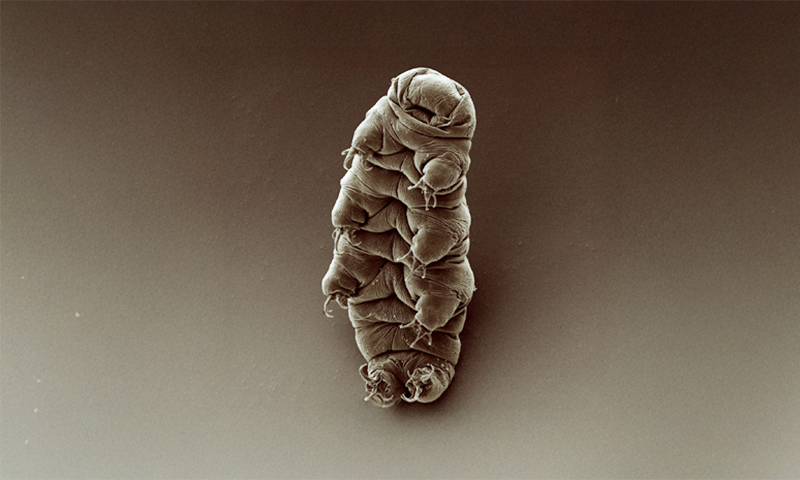
Water bears are some of the hardiest creatures on Earth: These whimsically-shaped microscopic animals can survive extreme radiation, hypothetical apocalypse, dehydration and starvation, and have even persevered in the harsh conditions of space. And yet, like so many other living things, they are still vulnerable when they first make their entrance into the world.
In the video below, you can witness a baby water bear, also known as a tardigrade, make its earliest stabs at independence. Under the microscope, the mother drags her babies around a petri dish in a large sack of partially shed skin. When she finally sloughs it off, one egg slips free, and the water bear inside pokes and prods with its mouth parts to break out of its shell to freedom.
According to tardigrade researcher Witold Morek of the Wellcome Sanger Institute, water bears have two egg-laying strategies. They can lay the eggs in the exuvium, the mother’s shed exoskeleton, or freely in the environment, he tells Nautilus over email. The eggs laid in the shed skin have smooth surfaces, while those laid freely tend to have more ornamented exteriors.
The common explanation, says Morek, though there is no experimental evidence for it yet, is that these different birthing strategies help babies stick in place in the moss or lichen where they are often born. The ornaments protect those who are shed directly into the environment from getting washed away by rain. The shed exoskeleton serves a similar purpose for the water bear eggs it contains.
Water bears got their nickname from a German theologian named Johann August Ephraim Goeze in the 1770s. He was one of the first to observe them under a microscope and chose the moniker due to their bulbous, bear-like shape and because he found them in a nearby pond. The tiny oddball creatures—which live in a vast range of environments, from moss to glaciers—have attracted the fascination of scientists and science enthusiasts ever since. Now we have a rare look at how these tenacious critters make the very first strides in their wild lives. 
Enjoying Nautilus? Subscribe to our free newsletter.
Lead image: Bob Goldstein & Vicky Madden, UNC Chapel Hill / Wikimedia Commons