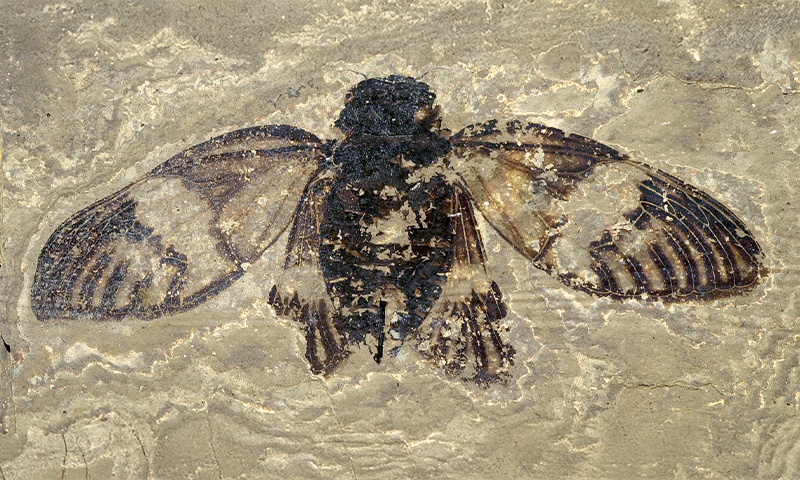
Scientists recently uncovered a 47-million-year-old fossil of a cicada in a rock formation in Germany. The find could help us chart the evolutionary history of this charismatic and troublesome insect.
Cicadas represent one of the most diverse families of insects in the world, with more than 3,000 documented species, but the fossil record they have left behind is surprisingly sparse.
The highly detailed fossil, shown here, belongs to a newly described genus and species, Eoplatypleura messelensis, which is now one of the oldest known representatives of modern-day cicadas in Eurasia. The species’ intricately patterned wings resemble those of modern cicada species that live across Africa and southern Asia, whose flappers help to camouflage them in scrubland and woods.
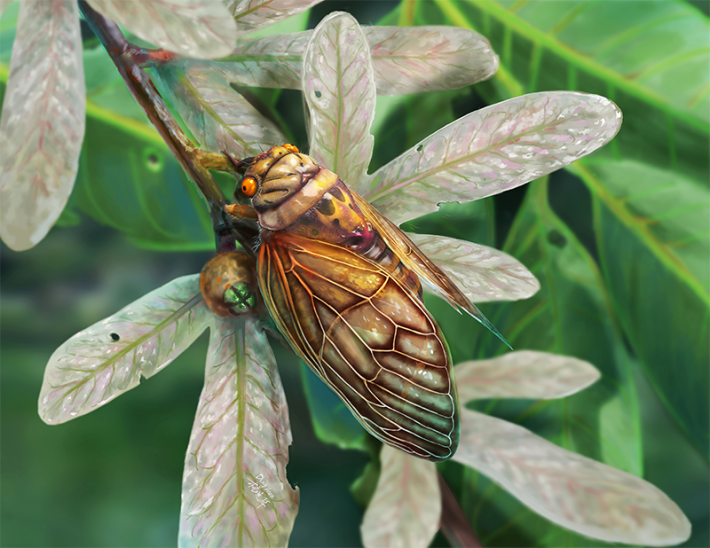
The fossil fills a gaping hole in the Eocene fossil record, an era spanning 56 to 34 million years ago, and could offer a helpful reference for future genetic studies that trace connections between species. The history of the broader family of “true cicadas,” also known as Cicadidae, is thought to stretch back up to 160 million years.
But the finding also muddles a past theory: The newly described species may belong to a group of cicadas that was thought to have left Africa around 20 million years ago. Given that the fossil is an estimated 47 million years old, this event may have happened 27 million years earlier than scientists believed.
In their populations across the globe, cicadas have played an outsize role in human culture: Their striking lifecycles have made them enduring symbols of rebirth and reincarnation in China. For the Hopi people, cicadas are considered spiritual messengers who led them into the present world. 
Lead image: Senckenberg