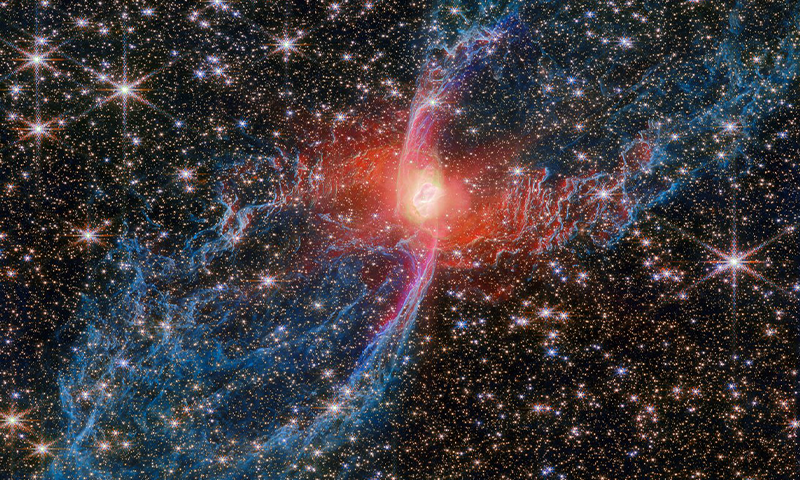
This eerie space scene, appropriately named the Red Spider Nebula, some 3,000 light-years from Earth, was captured in unprecedented detail by the James Webb Space Telescope and recently released online. Planetary nebulae like the Red Spider emerge when some stars near their demise. These nebulae are composed of the outer layers of gas discarded by dying stars, which release ultraviolet light from their sizzling cores that have been laid bare. This gives planetary nebulae their signature glow.
Such a stunning sight is only temporary—on the broader cosmic scale, that is, surviving for merely tens of thousands of years. “The planetary nebula phase of a star’s life is as fleeting as it is beautiful,” a recent statement notes.
The image was captured by JWST’s super sensitive near-infrared camera, which gathers light invisible to the naked eye and can glimpse the faint glow of some of the farthest and oldest objects detected in our universe. At the center of this nebular portrait, we see the nebula’s dying star—which has a surface temperature up to 50 times hotter than the sun.
The Hubble Space Telescope team released an image of the Red Spider Nebula in 2001, which was captured in shorter, optical wavelengths—but now, infrared imaging provides a much crisper look at this creepy crawler. For instance, the dying star looks more blue and faint in the Hubble image, compared to the fiery red appearance in the JWST shot, and you can make out “a shroud of hot dust surrounding the central star.”
Now, scientists can also see the spider’s entire “legs,” or the lobes of the nebula, a finding recently reported in The Astrophysical Journal. These bubble-like appendages span about 3 light-years, blown up by gas from the nebula’s center over millennia. 
Enjoying Nautilus? Subscribe to our free newsletter.
Lead image: ESA/Webb, NASA & CSA, J. H. Kastner (Rochester Institute of Technology)