A movie of the cosmos, updated every three days, is about to start running from a mountaintop in Chile. For the next 10 years, the Vera C. Rubin Observatory—named after the American astronomer who studied the effects of dark matter—will image millions of astronomical objects each day, or more than 100 every second.
Every three nights, the telescope’s advanced mount will reposition and stabilize it to create a high-quality mosaic of the night sky in ultraviolet, visible, and infrared light—an unprecedented chronicle that can be crossed-referenced against earlier observations.
The result will be an accurate and updated record of everything that appears or disappears—a precise “movie” that scientists can use to view how the cosmos changes over time, says University of Edinburgh astronomer Bob Mann, who heads the United Kingdom branch of the project.
“We have had wide sky surveys before [and] we have had surveys that go very deep in small regions of sky,” Mann says. “But this dataset will have an unprecedented combination of depth, spectral and areal coverage, and temporal resolution.”
That means Rubin is set to detect “classes of time-varying or transient phenomena that could not have been detected before,” Mann says. And these new phenomena could in turn unveil even deeper secrets of the cosmos, from its very beginning to its eventual conclusion.
Rubin will be nothing short of revolutionary in mapping the solar system.
The project will create an unprecedented flood of digital data that will be funneled via the internet to seven specialized data centers around the world, with the expectation that scientists almost everywhere can use it to search for new astronomical phenomena—and in the hope some could lead to new understandings of how the universe works.
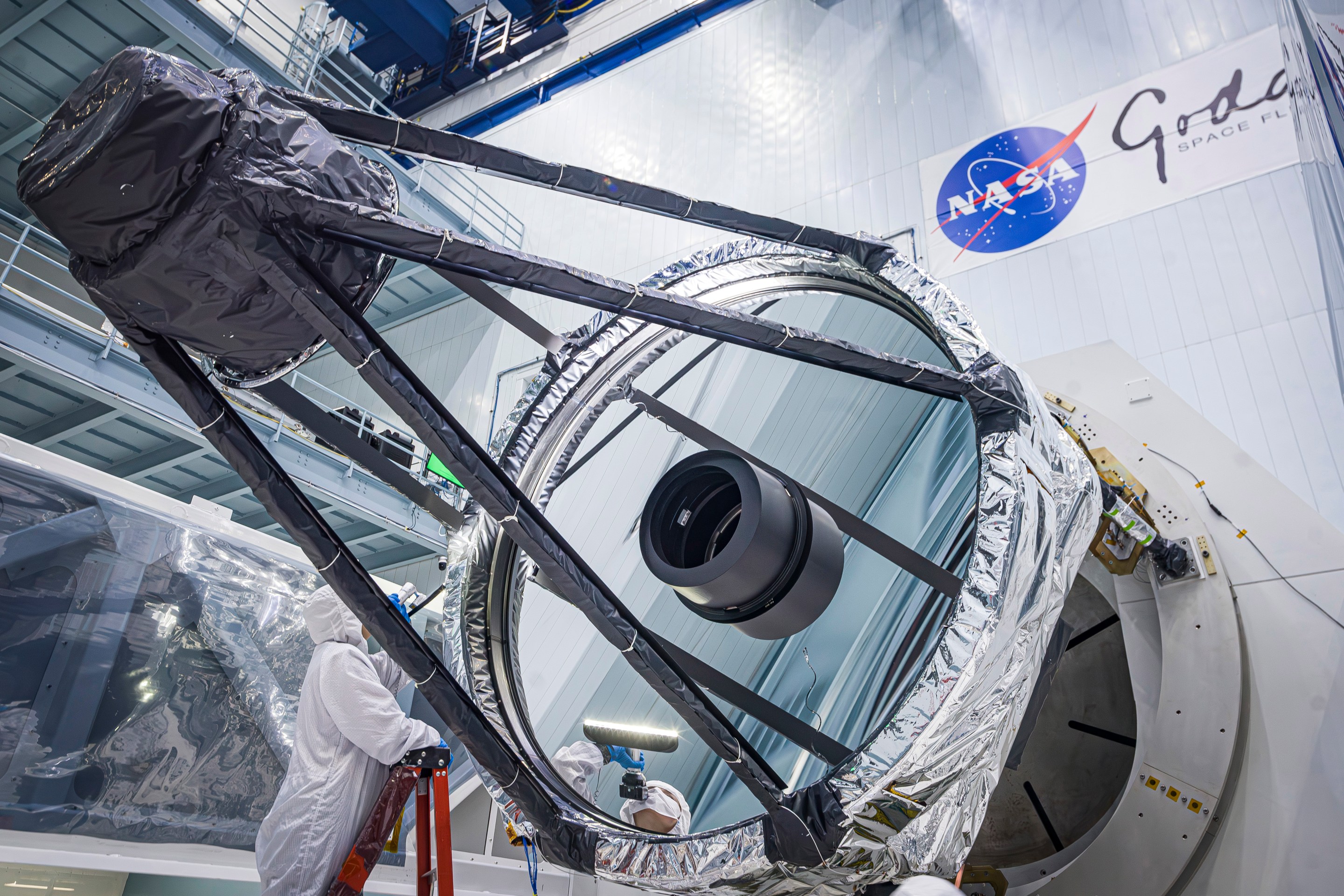
Sometime in late September, the observatory’s official “first photons” will flow into a simplified “commissioning” camera, as a test. But the full observatory won’t go online until early next year—including its main 3.2 gigapixel camera, a three-ton device with robotic filters and the largest digital camera ever built.
The observatory will complete a deep survey of the entire southern sky more than 800 times during its initial 10-year mission—a project called the Legacy Survey of Space and Time.
University of Washington astronomer and data scientist Mario Jurić, who will use Rubin’s data to explore the solar system, explains that changes in the sky can reveal a lot about the objects and processes that cause them.
“Seeing the ‘cosmos in time’ allows us to find objects that change brightness—think variable stars, supernovae, black holes in centers of distant galaxies devouring in gas and other stars,” he says. But Rubin will also detect almost any object that moves in the solar system, including asteroids, comets, and perhaps even unknown planets.
“Rubin will be nothing short of revolutionary in mapping the solar system and helping us understand its formation and evolution,” Jurić says.
This resulting flood of data will need special data centers to handle it: Scientists estimate the observatory will generate about 20 terabytes of data every night, for a total of about 60 petabytes over the 10-year survey—equivalent to 30 trillion printed pages.
University of Oxford astrophysicist Stephen Smartt is leading the United Kingdom’s effort to filter the results, and six other data centers—one in Chile, two more in Europe, and three in the United States—are also being prepared to deal with the data deluge.
Usually, international teams of astronomers and space scientists book time on the world’s largest telescopes to observe the particular astronomical objects and phenomena they are interested in. But the Vera C. Rubin Observatory will pioneer a different approach, by making deep observations of the entire southern sky every few days and providing the data to networks of scientists who can filter it for significant results.
Astronomer Igor Andreoni of the University of North Carolina at Chapel Hill, for example, will use the data to detect variable stars, which can change brightness over the course of several days. Astronomers have identified certain types of variable stars that pulse with predictable brightness over a distinctive period of time, so that they can be used as “standard candles” to measure astronomical distances.
Andreoni is hoping to witness “explosions marking the death of massive stars, collisions of compact objects, stars being ripped apart by black holes, and all sorts of cosmic drama,” he says. “The universe is a very dynamic place, from which we still have a lot to learn.”
University of California, Berkeley, astrophysicist Raffaella Margutti will use the same stream of data to search for “transient” astronomical phenomena that might only be visible for a few hours or less—such as the distinctive flashes of light given off by merging neutron stars, which could help scientists determine the exact nuclear processes that took place during the merger.
“The universe is all but static. It evolves, on any time scale,” Margutti says. “We are now in the position to map the sky as it evolves with time.” 
Lead image: Rubin Obs/NSF/AURA