The BepiColombo twin orbiters built by the European Space Agency (ESA) and the Japan Aerospace Exploration Agency (JAXA) first set off for Mercury on October 20, 2018, and have now arrived at the solar system’s smallest planet—just a little worse for wear.
Featured Video
An unexpected glitch back in 2024 forced the conjoined spacecraft to take a different route to Mercury, delaying its arrival by more than six months and putting our summer road trips into serious perspective.
After undergoing a delicate separation operation to split into two probes that will orbit Mercury, BepiColombo is tasked with studying the form, interior, structure, geology, and composition of the closest planet to the sun, as well as taking a close-up look at the craters on its surface.
Advertisement
Investigations undertaken through BepiColombo will include studying Mercury’s exosphere, magnetosphere, and the origin of the planet’s magnetic field. There should also be time to test Einstein's theory of general relativity.
As the twin orbiters start their work, here’s a look back at photos NASA has already captured of this mysterious planet.
One of the oldest photos we have of Mercury’s heavily cratered surface, which is why the image quality isn’t great. It was taken by the Mariner 10 probe in March 1974. Credit: NASA/JPLAnother shot from Mariner 10 on its Mercury flyby en route to the sun. The probe took thousands of photos of the planet throughout 1974 and 1975. This shot is of Mercury’s south pole. Credit: NASA/JPL
Advertisement
A mosaic of images from Mariner 10 of the more commonly seen, illuminated hemisphere of Mercury. Credit: NASA/JPLThe Messenger probe took over Mercury observation duties between 2011 and 2015. This composite image shows the differences in spectral reflectance across the planet, as seen by Messenger’s wide-angle camera. Credit: NASA/Johns Hopkins University Applied Physics Laboratory/Carnegie Institution of WashingtonAnother wide-angle camera shot from Messenger, this time of the prominent lobate scarp (that is, cliff-like landform) called Terror Rupes. This is also an iconic “limb” image that shows off a planet’s outer edge. Credit: NASA/Johns Hopkins University Applied Physics Laboratory/Carnegie Institution of WashingtonAn enhanced-color composite of the Caloris basin courtesy of Messenger. The basin is around 950 miles across—about the distance between New York City and Louisville, Kentucky. Credit: NASA/Johns Hopkins University Applied Physics Laboratory/Carnegie Institution of Washington
Advertisement
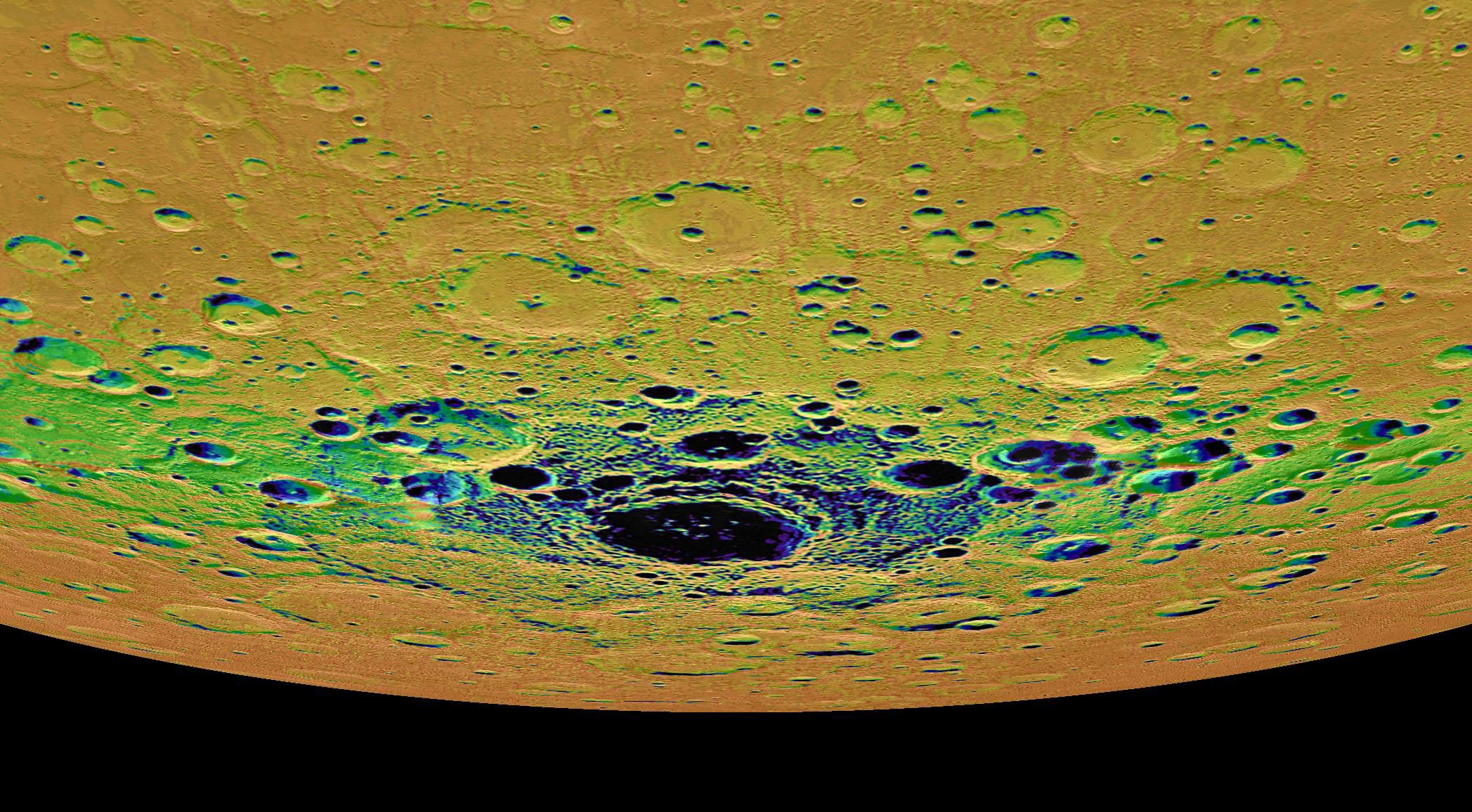
Researchers are particularly interested in Mercury’s gravity field. This image from Messenger reveals mass concentrations of gravity in red, which indicate anomalies in sub-surface structure. Credit: NASA/Goddard Space Flight Center Science Visualization Studio/Johns Hopkins University Applied Physics Laboratory/Carnegie Institution of WashingtonA close-up of the crater Apollodorus and the deep troughs surrounding it known as Pantheon Fossae. This image was snapped by the Mercury Dual Imaging System on board Messenger. Credit: NASA/Johns Hopkins University Applied Physics Laboratory/Carnegie Institution of WashingtonAn orthographic projection of Mercury’s south polar region captured by Messenger, colored by an illumination map, which shows how often an area gets sunlight. The deep blacks are areas of permanent shadow. Credit: NASA/Johns Hopkins University Applied Physics Laboratory/Carnegie Institution of WashingtonThe Mercury Atmosphere and Surface Composition Spectrometer on Messenger being put to good use to demonstrate how different wavelengths of light reflect different chemical compositions on the surface. Credit: NASA/Johns Hopkins University Applied Physics Laboratory/Carnegie Institution of Washington
Advertisement
Messenger eventually crashed into Mercury in 2015 after its mission was complete, and this is one of the last photographs it beamed back—a closer look at the many craters marking Mercury’s surface. Credit: NASA/Johns Hopkins University Applied Physics Laboratory/Carnegie Institution of Washington
David Nield has written about science and technology for more than 20 years. His work has appeared in a wide range of publications, including Wired, Popular Science, The Guardian, and Gizmodo.