Moon exploration has always made for good viewing. On July 20, 1969, somewhere between 600 million and 650 million people around the globe tuned in to watch NASA Apollo 11 astronauts Neil Armstrong and Edwin “Buzz” Aldrin cavort across the surface of the moon. The United States Department of State estimates that 94 percent of United States households that contained a TV set—some 53 million—had it locked on the live coverage. It was the biggest television audience ever, before being topped by the marriage of Lady Diana Spencer and Prince Charles in 1981.
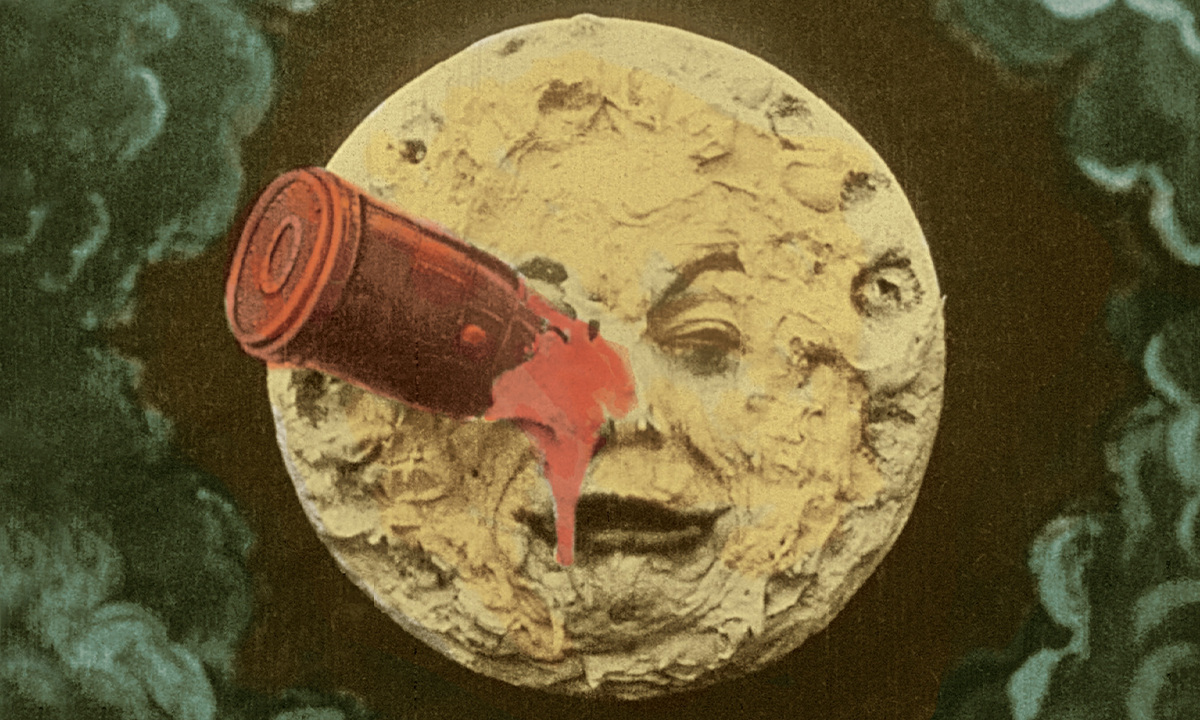
Before that French filmmaker Georges Méliès may not have attracted as big an audience with his 1902 sci-fi film Le Voyage dans la Lune (A Trip to the Moon), but the lunar romp did make The Village Voice’s list of the 100 best films of the 20th century, and maintains a coveted 100 percent on Rotten Tomatoes.
But both the live broadcast of that transformative lunar event and the earlier, fictional silent film that followed a rocket ship to the moon happened long before the dawn of social media. Not to mention before the now-ubiquitous reality that discerning viewers can access news and entertainment by reaching into their pockets instead of gathering around television sets or congregating in turn-of-the-century movie houses.
Enter Artemis II.
The four Artemis II astronauts aboard the Orion capsule for their 10-day trip around the moon and back appeared on a dizzying array of entertainment platforms. The stage of the journey that saw them slingshot around the moon, for example, streamed on NASA+, Amazon Prime, Apple TV, Hulu, Netflix, HBO Max, and Roku. The more consistently moon-curious could take in the entirety of the mission, from launch to splashdown, on NASA’s YouTube channel, which beamed video and images 24/7.
Read more: “The Phantasmagoria of the First Hand-Painted Films”
With this constellation of viewing options instead of a single channel on which to view the Artemis II moon mission, viewership numbers are all over the place and tough to congregate. According to The Hollywood Reporter, TV news outlets—including ABC, CBS, NBC, CNN, Fox News, and MS NOW—captured 27.3 million viewers with coverage of Artemis II’s return to Earth last week. And 18.1 million people watched the launch of the mission 10 days earlier on those same six networks (plus Telemundo), per media analytics firm Nielsen.
Add social media audience to those legacy outlet audience sizes, and the Artemis II crew approaches the exposure of Armstrong taking small steps and giant leaps. That NASA YouTube livestream? The splashdown stream attracted more than 650,000 viewers and more than 22 million watched the archived video. If you look at the X (formerly Twitter) accounts of the 4 Artemis II astronauts (Christina Koch, Victor Glover, Reid Wiseman, and Jeremy Hansen) alone, we’re talking nearly 1.3 million followers.
On its face, all this exposure can result in considerable influence. That’s something that hasn’t changed from the era of the black-and-white Apollo 11 broadcast. Some pre-social media astronauts transitioned from space travelers to the influencers of the day—politicians. In total, five NASA astronauts went on to win federal elections, three became U.S Senators and two were elected to the U.S. House of Representatives. These include Senator Mark Kelly (D-AZ) who was part of four space shuttle missions in the early 2000s and has recently attracted some 2028 presidential election scuttlebutt.
It's as yet unclear whether or not the Artemis II crew will hoe similarly traditional paths to widespread influence. But they certainly have more options in our current media age. Their scientific and technological contributions to future Artemis missions to the moon and to research on the ravages of spaceflight on the human body, among other insights, cannot be overstated. And now that they’ve returned to Earth having captured the imaginations of whole new generations, they could potentially parlay their considerable audiences into any manner of influence, commercial, political, and so on.
They’re still making the media rounds to discuss their historic feat, as they should. After the fervor subsides and the torch is passed to the next cohort of space pioneers, the Artemis II space travelers will have to think about their next stage of influence back here on terra firma. 
Enjoying Nautilus? Subscribe to our free newsletter.
Lead image: Georges Méliès's 1902 film, Le Voyage dans la Lune (A Trip to the Moon) poster / Wikimedia Commons.