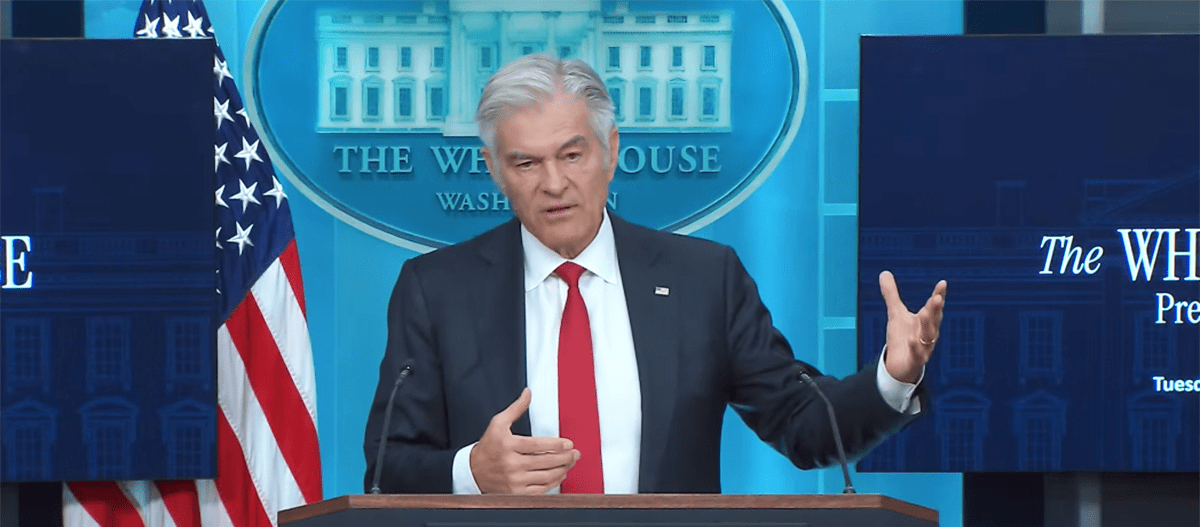
Dr. Oz has quite the prognosis for anyone who disagrees with the policies of the Trump administration. Essentially this: There’s no cure for what ails you. The United States Administrator of the U.S. Centers for Medicare and Medicaid Services took his turn at the White House podium yesterday for Press Secretary Karoline Leavitt, who is on maternity leave. The heart surgeon-turned Oprah sidekick-turned television personality-turned cabinet member answered a question from the press pool about folks who dislike President Donald Trump and suffer from the made-up “Trump Derangement Syndrome,” as the questioner asked.
“I am concerned about folks who have focused their entire life energy on dislike of the president,” he said. “It’s disheartening to see people lost in that way.”
“Any medical advice?” prodded the questioner.
“Treating stupid is really hard …” Oz added.
Tell me about it, Doc.
That an administrator charged with ensuring the health and wellness of the U.S.’s most vulnerable people offered no treatment for a fictitious syndrome, invented to minimize opposition to a president who seems to revel in courting opposition, is not exactly surprising. What is surprising is that Oz spent more than 35 minutes speaking to the press without having to address the Trump administration’s latest assault on science.
Read more: “Trump’s War on Science Continues”
Oz spent the bulk of his time talking about the Trump administration’s drug pricing schemes and combatting Medicaid and Medicare fraud. But when asked (incidentally, by the same reporter who asked the Trump Derangement Syndrome question) about preventing COVID-19 vaccine mandates in the future, Oz weighed in more broadly on the support of research in the U.S. “We need gold standard science,” he said. “We need that science to be able to help families make better decisions for themselves … If we can do this in the right way, it will be very empowering.”
I’m not sure what Oz sees as “the right way,” but just last week the White House announced that the president’s Office of Management and Budget (OMB) would seek to replace the system of peer review that determines which scientists win research funding from the federal government with judgements made by political appointees who have sworn fealty to Trump. The plan also proposes banning many collaborations between U.S. and foreign researchers as well as ending the practice of scientists using grant money to publish their findings in open-access journals.
“What OMB is proposing is not a reform of grants management,” Elizabeth Ginexi, a former program officer at the National Institutes of Health, wrote in a Substack post in response to the announcement. “It is a complete political control apparatus layered over every stage of the federal science funding lifecycle.”
Doesn’t sound like quite the right way to get to “gold standard science” in my humble opinion.
H. Holden Thorp, chemist and editor in chief of Science, appears to agree. In an editorial published yesterday, Thorp wrote that the OMB proposal “would inevitably lead to unlegislated reductions in funding and damage U.S. leadership in science, both in academia and industry.”
Thorp implored the scientific community to “flood OMB with responses” during a public comment period meant to capture sentiment on the announced changes that lasts through July 13. “The red light is now flashing,” he wrote. “All hands, report to stations.”
Hopefully, we can weather this latest attack on science and the U.S. can focus on a robust, transparent, and fair system of funding scientific research. Maybe then we can get to work on some treatments for stupid. 
Enjoying Nautilus? Subscribe to our free newsletter.
Lead image: The White House / YouTube