Blinking is a natural reflex. We blink in response to startling stimuli, such as bright lights, loud noises, or objects approaching our eyes. We also blink to keep our eyes moist. Adult humans blink 10 to 20 times per minute, each blink washing our eyes with fresh tears. Thanks to our natural windshield wipers, our eyes stay lubricated, clean, and protected from pokes. But new research suggests that we also blink as part of our brains keeping time.
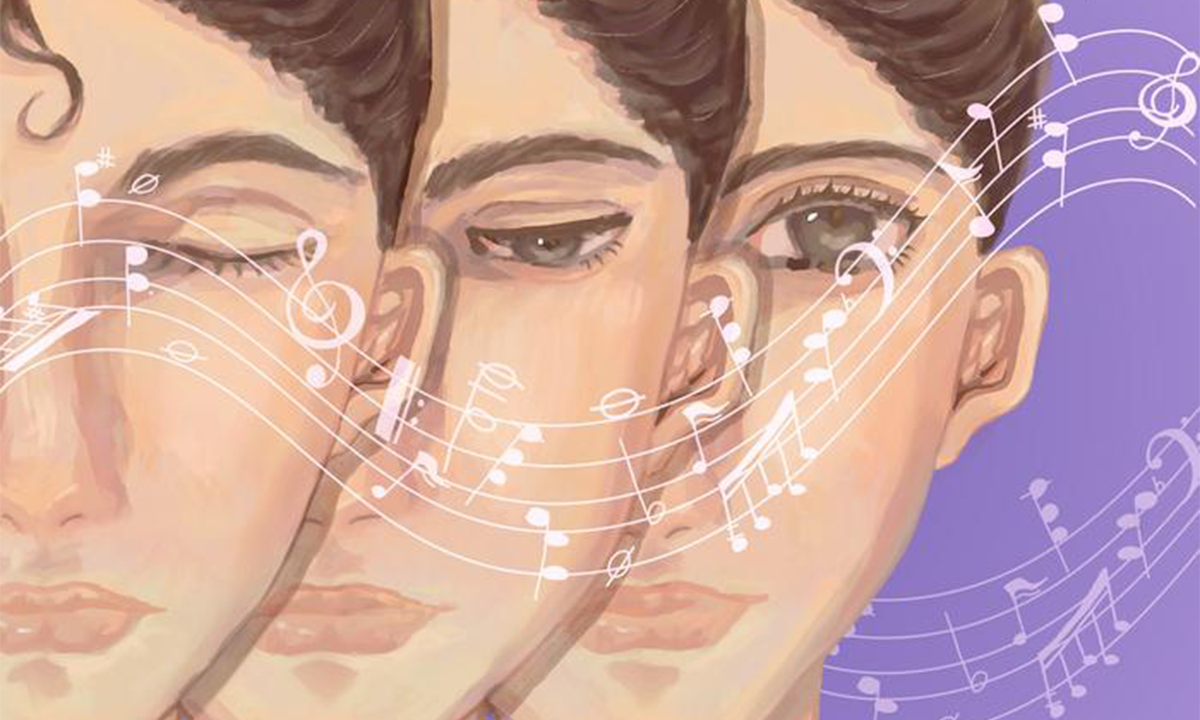
Cognitive scientists Yi Du and co-authors at the Chinese Academy of Sciences experimented with 123 young people to investigate the association of blinking with music as they listened to chorales by Johann Sebastian Bach. The researchers intentionally chose nonmusicians who were less likely to have deliberately cultivated musical rhythm. Through observing the behavior, tracking their eyes, and recording neural responses via EEGs, the researchers found that the participants blinked spontaneously in time with musical beats. They published their findings yesterday in PLoS Biology.
Just in case the blinking was activated by hearing familiar music, the researchers played the Bach chorales backward in some trials to eliminate song recognition. The results were the same; blinking kept pace with the rhythm of the music. “We found that people’s spontaneous eye blinks fall in step with the musical beat—even without being told to move—revealing a hidden link between hearing music and the oculomotor system,” Du said in a statement.
Read more: “When You Listen to Music, You’re Never Alone”
The EEGs recorded by Du and her colleagues showed participants' brain waves syncing up with their blinking eyelids and the beats. They suggested that this auditory-motor synchronization occurs unconsciously as we hear music with a steady tempo (so, don’t expect to blink in time with free jazz, for example). The researchers were able to disrupt this eye-brain synchrony by giving the participants a simple, unrelated task to do while they listened to music. The distraction of a red dot appearing on a screen was enough to end the beat-locked blinking.
Blinking now joins the ranks of finger tapping and head nodding as a motor behavior that naturally keeps the beat, only we’re not as aware of our blinking. The researchers hypothesize that it’s an involuntary response that may stem from a primitive rhythm-processing instinct rooted in our evolution. “As someone who studies rhythm and prediction, I was struck that the eyes keep time with the ears—it’s an elegant, everyday signature of the brain’s timing mechanisms,” added Du.
Life can change in the blink of an eye, or those blinks may just be tracking life’s rhythms. 
Enjoying Nautilus? Subscribe to our free newsletter.
Lead image: Yuxi Gao