We know that humans can maintain a beat, keeping time deep in our neurons. So can macaques and fireflies. But, to date, the ability to learn a rhythmic sequence and then recognize it at a different tempo (like a high-speed “Happy Birthday” song) has been largely limited to us and a few other vertebrate animals.
You can now add bees to the list.
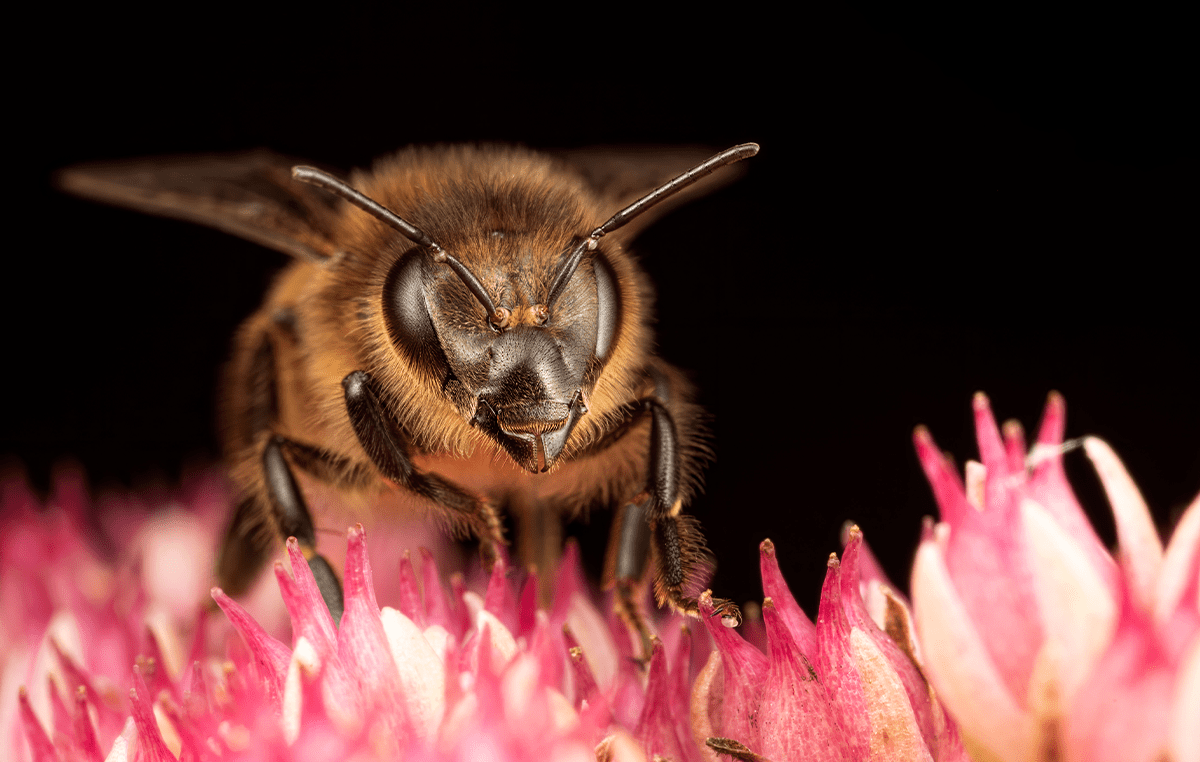
In a new study, researchers from Southern Medical University in China and Macquarie University in Australia tested bee rhythm-learning with sequences of flashing lights. First, to assess rhythm recognition, they exposed 20 bees to fake flowers containing LED lights. One pattern of flashing lights resulted in a sugar reward, while another pattern resulted in bitter quinine. After bees had been trained on the two patterns, they were tested without rewards. Most chose the pattern that had been rewarded before.
To make sure they weren’t cueing in on differences in features like brightness, total number of flashes, or flash length, a follow-up experiment challenged bees to recognize flashing patterns that differed only in rhythm structure. Again, the bees chose the pattern that had previously come with a reward. Even when the flashing patterns were offered at different tempos, the bees proved able to recognize the reward-worthy pattern.
Read more: “The Dreams of a Bumblebee in Autumn”
“These findings suggest that an insect brain can encode and generalize arbitrary complex temporal patterns, which suggests that abstract rhythm perception can emerge from relatively simple neural architectures,” concluded the study authors.
The researchers hypothesized that the flashing LED lights stimulated the bees’ neural pathways that process “optic flow,” or the sequences of light and dark that bees perceive when flying. Although bees may not need to recognize rhythm patterns, their optic flow sensors, known to serve in insect navigation, may nevertheless make it possible.
The rhythm recognition could also be a broader capability possessed by all animals. It could, for example, be tapping into perceiving visual landscapes at distinct scales, like when you recognize the Eiffel Tower in person versus when you see it in a postcard. Arguably, all animals need to maintain visual recognition from different perspectives. As such, the study authors suggest that we may be moving “from a narrow, anthropocentric view of rhythm to one in which temporal intelligence is a pervasive, adaptive trait across the animal kingdom.”
In the end, we might just all be slaves to the rhythm. 
Enjoying Nautilus? Subscribe to our free newsletter.
Lead image: Paul Steven / Adobe Stock