Typhon, the deadliest monster in Greek mythology, had a human upper torso, viper coils for a lower torso, and many dragon heads where a single human head should have been. In his first battle with Zeus, ruler of the Greek pantheon of the gods, he won (though he would eventually end up defeated and trapped under a mountain).
This hybrid beast was one of many among ancient myths, most of which we understand today to be impossible. A mammal, for example, cannot produce an offspring with a bird. Even if “equipment” issues were sorted out, their chromosomes are incompatible. If an egg could be fertilized at all, it would not divide properly.
But modern practices of keeping dissimilar species in captivity next to each other have produced a variety of honest-to-goodness, real-life hybrids. What the Greeks could only imagine, zoos have made flesh and blood. For the offspring to be viable, the parent species must not be too dissimilar. “The immune system is set up to attack foreign things from getting into the body, and if an embryo or fetus is too foreign genetically, the body will attack it,” says George Siedel, professor of biomedical sciences at Colorado State University.
Even if the parents are genetically similar enough, it is difficult to predict how the fruit of their union will look. In some cases, dominant traits (like a Zebra’s black stripes) will prevail, but there are no hard and fast rules.
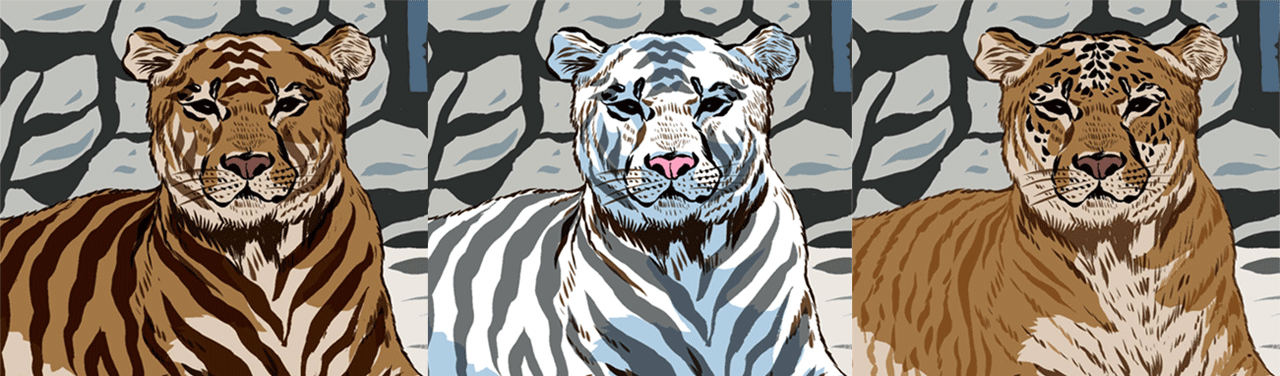
Below are five sets of illustrations of hybrid animals. Each set contains one real hybrid and two fakes. Can you guess which one is the real thing? Click on your choice to see the answer.
Loren Grush is a science and health writer living in New York City. She has written for Fox Health, Fox SciTech, and ABC News.