They’re everywhere!
Colorful, plant-hopping spotted lanternflies have become a ubiquitous sight in the eastern United States. The larvae are unmistakable too—white spotted on a black and red triangular body, they cover tree trunks in hordes. Originally from China and South Korea, spotted lanternflies (Lycorma delicatula) gained a foothold in 19 U.S. states over the past decade. They threaten crops like grapes, soybeans, peaches, and apples, but despite intensive eradication efforts, they’ve continued to spread.
The trick to getting rid of them is to catch them at the egg stage before they’re mobile and reproductive. But the egg masses—consisting of 30 to 60 eggs laid by females on flat surfaces, such as bark or rocks, and then sealed with a waxy coating—are hard to find. The coating is at first glossy white, but it quickly dries to a grayish brown that can easily be mistaken for mud or lichen.
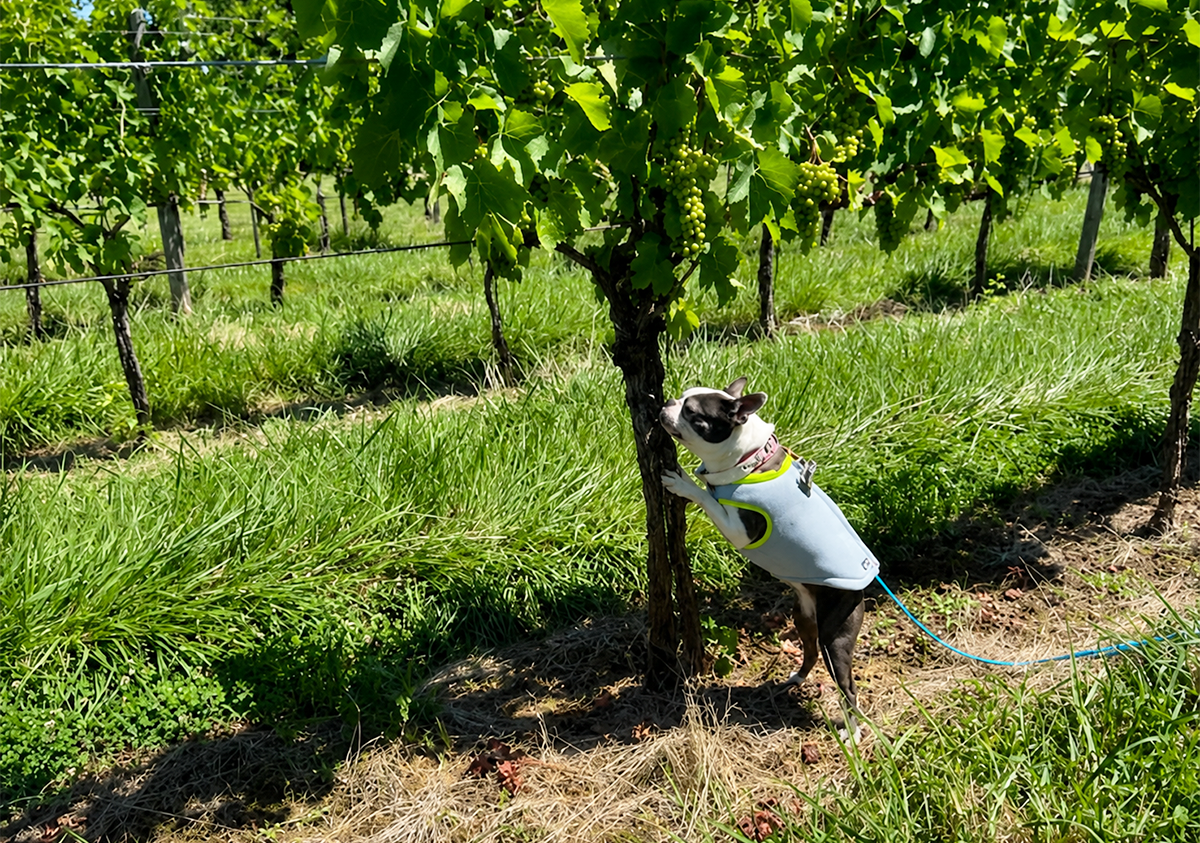
Last year, however, Virginia Tech and Texas Tech researchers found that dogs could be trained to sniff out lanternfly egg masses. In controlled tests with 182 dog-owner pairs, dogs were 82 percent successful in picking out boxes containing lanternfly egg masses versus other fragrant items. Their recent follow-up study—detailed in a new paper in the journal PeerJ—challenged trained dogs to find lanternfly egg masses in the complex environments where they naturally occur.
Read more: “AI-Powered Rescue Dogs”
A selection of 26 teams from the original cohorts of dog-owner pairs participated in the study. First, to determine the maximum detection range, target egg masses were placed at varying distances in the field around a centerline walked by the dogs with their handlers. Next, nine dog-owner pairs were sent into wooded sites to spend 10 minutes looking for spotted lanternfly eggs. While the sites represented likely habitats for lanternflies, the researchers and dog handlers had no prior knowledge of lanternfly locations.
In the detection range testing, dogs could smell about half of the egg masses placed 16 feet or less from their walk line. From 16 to 33 feet away, their detection rate declined to 28 percent, still remarkable for an entirely scent-based detection. In the natural settings tests, dogs found an average of three egg masses per half acre, which left humans in the dust. People trained to find lanternfly egg masses were sent into the same sites and came back with detections of only 1.3 egg masses per half acre.
“What this means is that we can turn to everyday dogs and their owners and train them as a flexible early detection force,” explained lead study author Erica Feuerbacher, an animal behaviorist at Virginia Tech, in a press release.
She envisions a future network of household dogs trained to root out lanternflies as well as perhaps lend a paw for other agricultural issues such as “hitchhiker insects, invasive species, (and) diseases.”
Good dog! 
Enjoying Nautilus? Subscribe to our free newsletter.
Lead image: Photo courtesy of Debi Persing