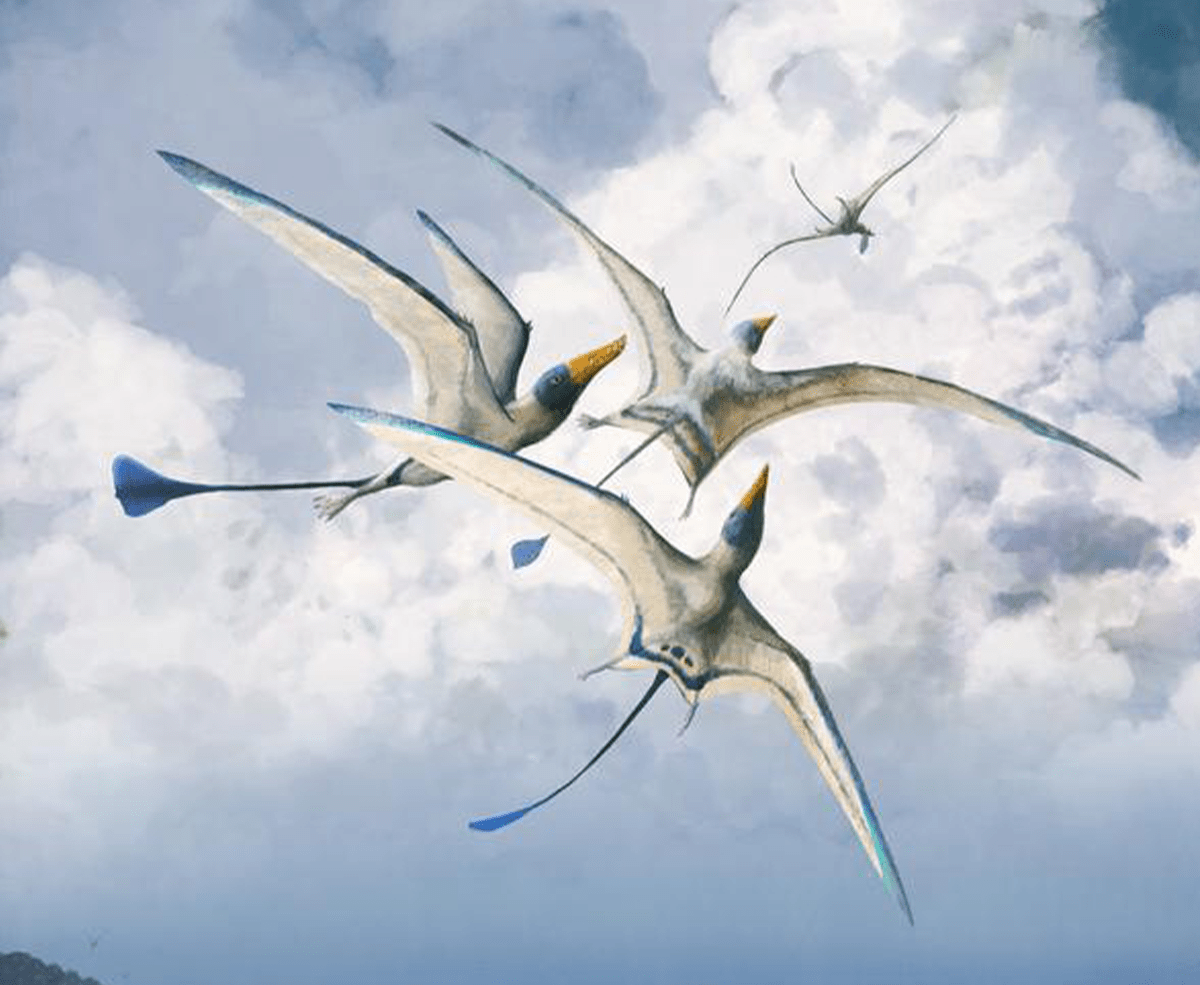
Pterosaurs were the first vertebrates to evolve the ability to fly. Unfortunately, they didn’t leave a lot of clues about how they managed this feat. While there are plenty of pterosaur skeletons, preserved wing structures are relatively rare and tend to be incomplete. So paleontologists and paleoartists are left to offer their best guesses on how their leathery wings were configured, and a new study published in Paleobiology has found these reconstructions to be lacking.
Using a technique called “theoretical morphospace,” paleontologists from the University of Bristol in the United Kingdom created maps of all the different wing types nine different pterosaur species could have had. (It’s the same method a different group of researchers used to investigate the shapes of bird wings in a study published earlier this year.) They then mapped the current reconstructions on top and discovered that they tended to cluster. Basically, they likely don’t reflect the diversity of pterosaur wings that actually existed.
Read more: “Conjuring Imaginary Creatures”
For example, the largest pterosaur, Quetzalcoatlus, had a wingspan the size of a single-engine Cessna and likely soared for long distances. One of the smallest, Anurognathus, was an insect-eating forest-dweller, adapted for more maneuverable flight. The reconstructions of the two pterosaurs’ wing shapes, however, overlap. According to the researchers, this means something’s off.
“In living flying animals, such as birds and bats, different lifestyles are associated with distinct wing shapes and flight abilities,” study author Benton Walters said in a statement. “The lack of comparable diversity in pterosaur reconstructions suggests that the reconstructions are missing important variation.”
So what’s the solution?
The researchers say that paleontologists need to reach a consensus on the structure of pterosaur wings and stick to it. “Otherwise, pterosaur reconstructions will remain a visual shorthand,” they wrote, “but one that poorly reflects the living animal and is unfit to fly.” 
Enjoying Nautilus? Subscribe to our free newsletter.
Lead image: Mark P Witton