You can tell a lot about Homo sapiens from their joints. Mainly, you can tell that our species seems anatomically ill-adapted to our lifestyle.
This very lifestyle, of standing and walking on two legs unlike some of our primate predecessors, may have been key to supercharging the survival and reproductive advantage of our ancestral species. But oh do our joints—the body parts that do the heavy lifting of supporting this jauntily upright strategy—pay the price.
Knees ache, ankles sprain, hips break, and don’t even get me started on backs. Each of us walks around in a body that has many more millions of years of mammalian non-uprightness etched into the evolution of joints that have changed marginally to support a relatively recent bipedal existence.
Our spines, originally designed to act as a rafter under which hangs a belly and chest full of organs, now act as columns to support the whole tippy enterprise of bipedalism. “By being bipedal, we’ve turned that spine vertical, a bad idea,” Dartmouth College paleoanthropologist Jeremy DeSilva once told Nautilus editor Kevin Berger. “And to make sure that the torso is oriented over the hips, and that all of our joints are aligned and balanced, there’s a curve that’s introduced into the spine.”
See? Ill-adapted. Humans are one of the only mammals to develop scoliosis and other spine problems, and some 60 to 80 percent of adults across the globe have experienced low back pain during their lives.
DeSilva went on to bemoan the state of H. sapiens’ foot. “If you were going to challenge an engineer to design a structure that has to be compliant enough to absorb forces from the ground, but then rigid enough to push off the ground, and maybe even elastic enough that it can absorb some energy to push off the ground,” he told Berger, “the last thing they would do is make it out of 26 parts.”
Guess how many bones are in the human foot?
That illogical construction owes to the fact that we evolved from apes who made their livings in the trees. One needs all those foot bones to navigate a maze of branches and grip branches all day. Not so much for walking to the corner store. “By evolving bipedalism, natural selection can only work with pre-existing forms,” DeSilva added. “It tinkered with this ape foot. I think of it as using duct tape and paper clips to patch together and stiffen up this foot.”
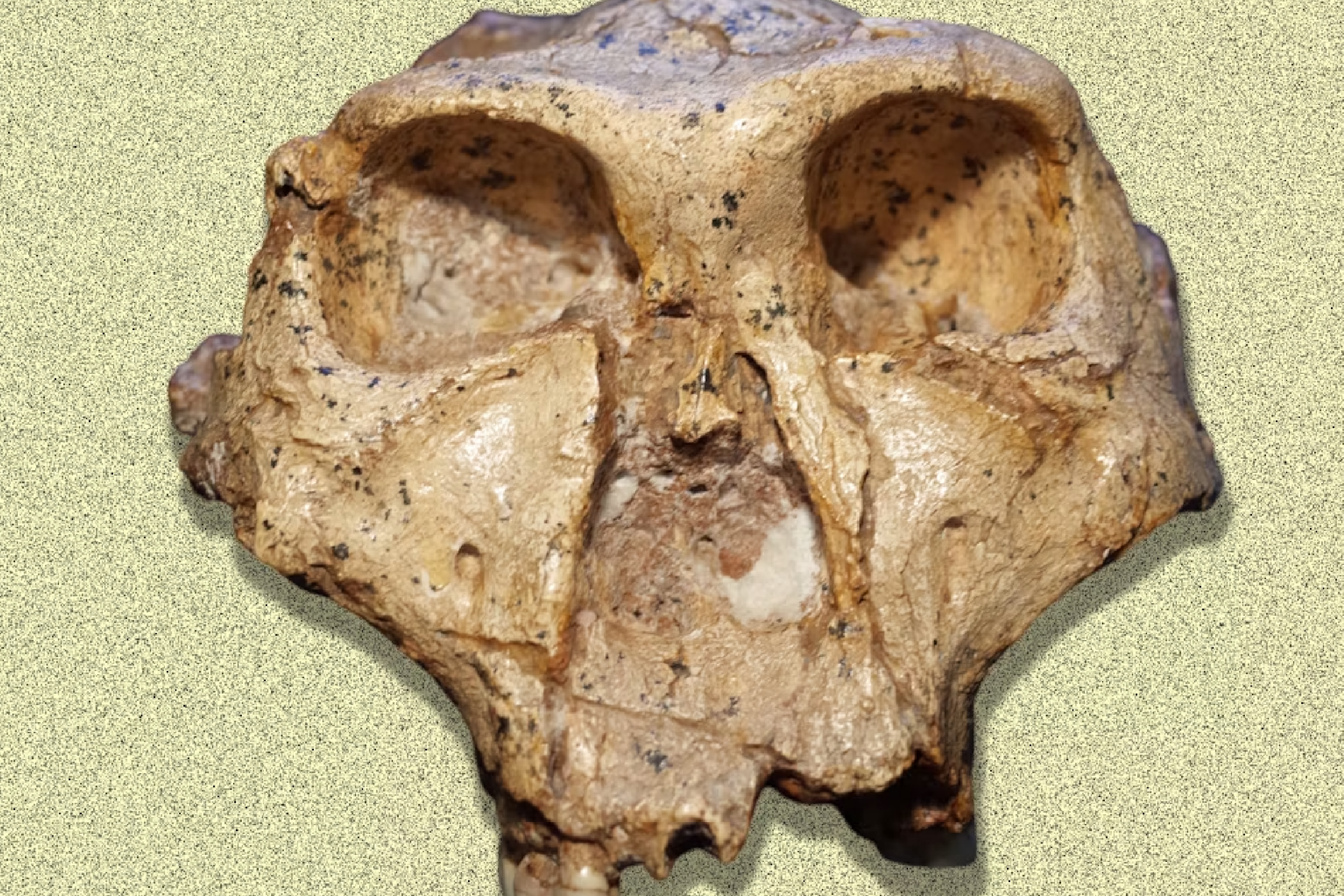
Recently, researchers working in the human evolution crucible of Africa shed some light on how ankle construction, in an ancestral hominin species called Ardipithecus ramidus, points to a model where our species derived directly from a species that was not unlike the African apes of today—that is, from primates that inhabit the trees. A study published this month in Communications Biology posits that the 4.4-million-year-old A. ramidus fossil ankle contains numerous similarities to the ankles of chimpanzees and gorillas that are around these days.
Since scientists believe that A. ramidus walked upright, the authors suggest that it could be a true transitional species between tree-living and bipedal primates. The findings essentially tweak earlier interpretations of human evolution, where living apes such as chimpanzees and gorillas were viewed as evolutionary dead ends, to suggest that the species that form the link between upright humans and forest apes may have been more of the latter.
Whatever the case, the reality we living H. sapiens must deal with is that our joints will eventually fail us, by injury or by age. As Bruce Latimer, director of the Center for Human Origins at Case Western Reserve University, once told Nautilus about knees, “You take the most complex joint in the body and put it between two huge levers—the femur and the tibia—and you’re looking for trouble.”
Sure. A ball-and-socket joint might function better than the hinge that is our knee, Latimer continued, but natural selection has simply not had the time nor the impetus to accommodate all the uniquely human physiological challenges—ultra marathon running, rugby, etc.—we subject them to. “We didn’t need it,” Latimer explained. “We didn’t know about football.” 
Lead image: Svetolk / Shutterstock