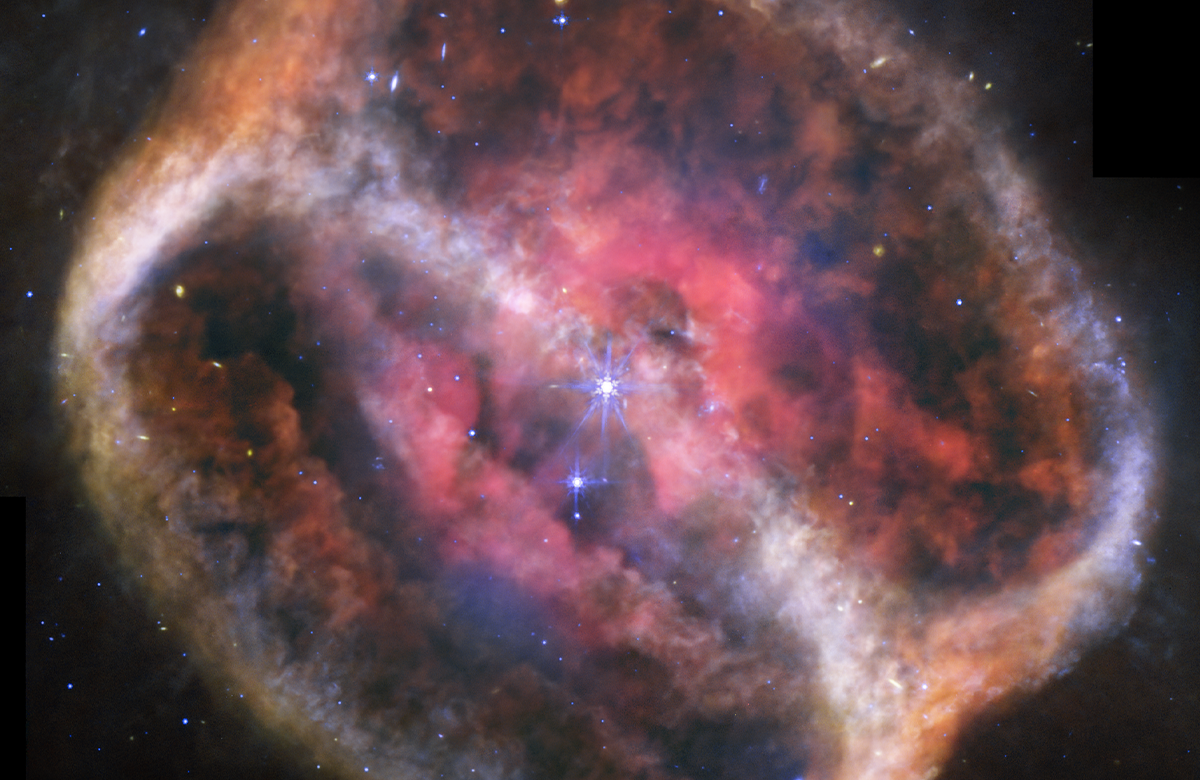
Crystal balls are typically used to gaze into the future, but this image of the Crystal Ball Nebula is actually a vision of the past. Captured by the Gemini North telescope located high atop Hawaii’s Mauna Kea peak, the light emitted by the nebula traveled 1,500 light-years to reach Earth. The milky white cloud comes from the remnants of the explosive death of one of the two stars that make up the binary system nestled within.
The Crystal Ball Nebula was first discovered by the German-British astronomer Frederick Herschel in 1790. The nebula’s spherical appearance led Herschel to believe it surrounded a planet so he used the term “planetary nebula” to describe it, a designation that’s still in use today.
Read more: “The Planets with the Giant Diamonds Inside”
While Herschel was an avid astronomer, his scientific exploits weren’t limited to the cosmos; he experimented with optical physics, too. Using a prism to split visible light into its many colors and a thermometer to measure their temperatures, Herschel noticed that there was another invisible wavelength lurking just below red. So, in 1800, he announced the discovery of infrared light.
It’s that longer wavelength that instruments onboard the James Webb Space Telescope detect, and below is an image of the Crystal Ball Nebula in mid-infrared. In this detailed image, you can more clearly see the two stars in the binary system and the rings of cosmic gas that surround them.
Herschel may have died in 1822, but his legacy is still burning bright 200 years later. 
Enjoying Nautilus? Subscribe to our free newsletter.
Lead image: NASA, ESA, CSA, STScI, Michael Ressler (NASA-JPL), Dave Jones (IAC)