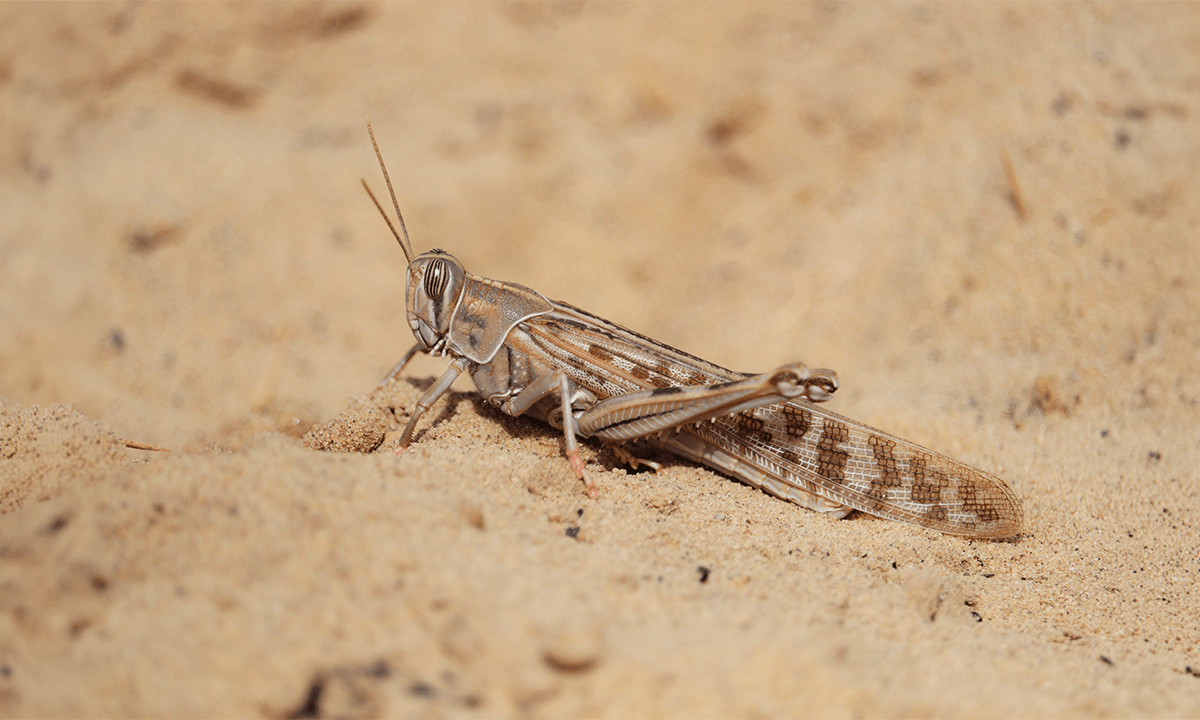
Locusts have plagued humans since antiquity, erupting into swarms so devastating that they serve as stand-ins for divine wrath. Sometimes containing tens of millions of voracious insects, these swarms can blot out the skies, decimate crops, and cause famines. In fact, just this week, massive clouds of desert locusts battered cars crossing the Sahara and descended on tourists in the Canary Islands. But what causes them to start swarming in the first place?
Living their lives as loners in their solitary phase, desert locusts typically take care to avoid each other. But when conditions crowd them in close proximity they enter their gregarious phase. While this charming designation conjures up images of grasshoppers mixing at a cocktail party, the reality is much more dramatic. They literally transform: Their bodies become shorter, they change color, and they start releasing a pheromone that causes them to be attracted to one another. And suddenly, they become a swarm.
The desert locust’s Jekyll-and-Hyde routine is triggered by a number of factors. Scientists have found seeing other locusts isn’t enough to provoke it, smelling them isn’t enough either, but both stimuli together can, as can repeated bumps to the hind legs. In the locust brain, these stimuli cause a spike in serotonin, the same neurotransmitter responsible for feelings of happiness in humans, causing them to seek out their winged brethren for an insect bacchanal.
Read more: “How Darkness Can Illuminate the Insect Apocalypse”
This striking transformation can even pass to their offspring, with locusts in the gregarious phase needing one or more generations to settle into their solitary phase again when reared in isolation. That means locust swarms that start breeding can transform from a nuisance into a devastating force of nature. According to the United Nations, a swarm covering less than half a square mile can consume what 35,000 people eat in a day.
What can we do to stop swarming behavior?
Not much. Extreme swings in weather, like heavy rains followed by droughts, cause the population booms and crowding that trigger swarms—a scenario made more likely by climate change. The U.N.’s Desert Locust Information Service monitors emerging swarms and helps coordinate a response, but that often involves spraying harmful organophosphate insecticides. There are safer alternatives, like fungal spores, but with a short shelf-life and high sticker price, they’re not as commonly used.
Instead we’re left to do what humans throughout antiquity have done. Watch the skies—and pray. 
Enjoying Nautilus? Subscribe to our free newsletter.
Lead image: Ismael Khalifa / Shutterstock