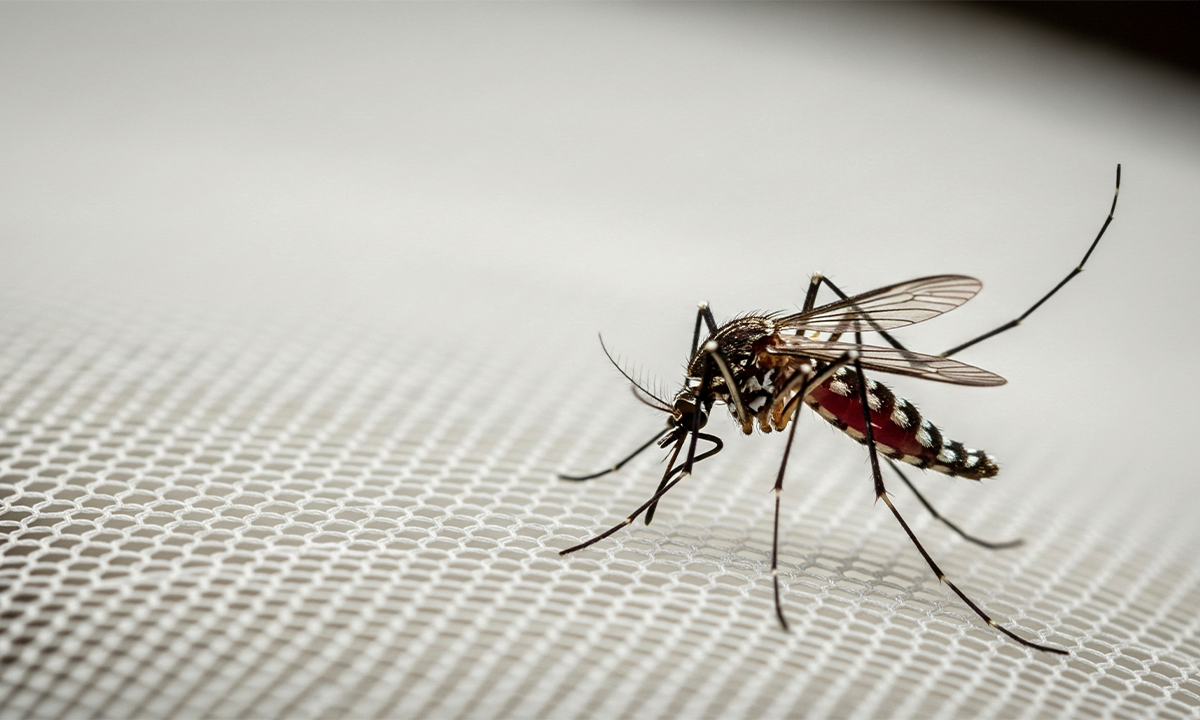
Spring is here, which for many in the United States, means mosquito season is right around the corner. If you’re one of the unlucky people who seem to be irresistible to the tiny bloodsuckers, you may want to pay attention to new research published in Science Advances about how and why they swarm.
To study the behavior of Aedes aegypti, one of the most common mosquitoes in the U.S., a team of researchers from Georgia Tech conducted three experiments using a chamber filled with hundreds of the insects surrounded by 3-D infrared cameras to track their flight patterns.
First, they placed a black sphere in a chamber. While the mosquitoes were attracted to it, they only seemed to notice it if they were flying toward it and didn’t spend long investigating. Swapping the black sphere for a white one and adding carbon dioxide revealed that mosquitoes could slowly find the target, but only if they were close by. A black sphere plus carbon dioxide, however, proved to be particularly enticing to the little vampires.
Read more: “As Biodiversity Dwindles, Mosquitos Turn to Human Blood”
“Previous studies had shown that visual cues and carbon dioxide attract mosquitoes. But we didn’t know how they put those cues together to determine where to fly,” study co-author Christopher Zuo said in a statement. “They’re like little robots. We just had to figure out their rules.”
After learning the aforementioned rules, Zuo then made the ultimate sacrifice to science—he offered up his own body. Donning a black, white, or combination ensemble split down the middle, he stepped into the chamber, allowing the mosquitoes to swarm him. Most of their swarming activity focused on the head and shoulders, the mosquitoes’ favorite places to dine (and don’t worry, Zuo says he didn’t suffer that many bites).
After sending the data to their collaborators at the Massachusetts Institute of Technology for analysis, the team determined that mosquitoes aren’t following the crowd. Instead they each independently follow visual cues and carbon dioxide to arrive at their destination.
“It’s like a crowded bar,” study co-author David Hu explained. “Customers aren’t there because they followed each other into the bar. They’re attracted by the same cues: drinks, music, and the atmosphere. The same is true of mosquitoes. Rather than following the leader, the insect follows the signals and happens to arrive at the same spot as the others. They’re good copies of each other.”
The team hopes this new research will lead to better mosquito control technology.
“One tactic is using suction traps that rely on steady cues, such as continuous CO2 release or constant light sources, to attract mosquitoes,” Zuo said. “Our study suggests using them intermittently, then activating suction at intervals, might be better. That’s because mosquitoes don’t tend to stick around their target when both clues aren’t used at the same time.”
Until we build a better mosquito trap, remember to wear light colors this summer—it just might save you from becoming a mosquito feast. 
Enjoying Nautilus? Subscribe to our free newsletter.
Lead image: SILVIA MAQQ / Shutterstock