One question for Jillian Scudder, an astrophysicist at Oberlin College and author of The Milky Way Smells of Rum & Raspberries: ...And Other Amazing Cosmic Facts.
How will the universe evolve?
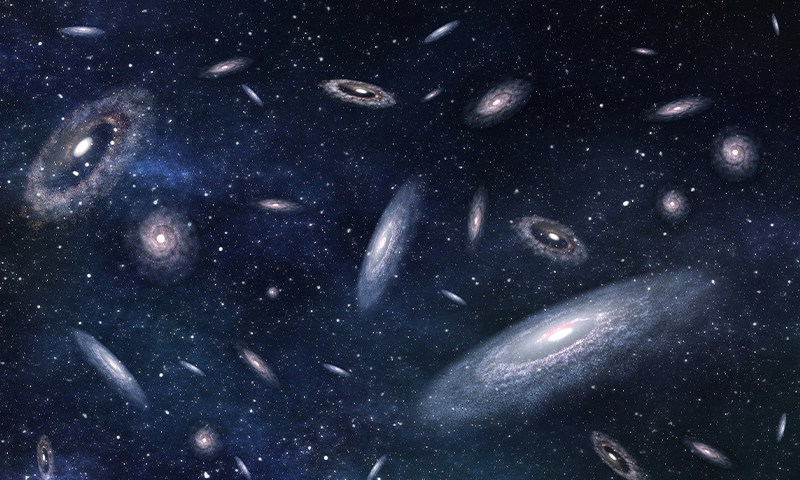
It depends on how far forward you let the clock run. There is a period of time where things that are gravitationally held together, will stay gravitationally held together for quite a long time. So the group of galaxies that we're part of has the Milky Way and Andromeda—the Milky Way and Andromeda will collide at some point about 4 billion years in the future.
I think the last major collision for the Milky Way galaxy was somewhere around 9 to 11 billion years ago, when it collided with Gaia Enceladus, the remains of a dwarf galaxy. Our collision history has been pretty quiet for the last long while, many billions of years. We will ruin it again with Andromeda. There will be another very massive disruption to the Milky Way at that point.
Then we've got a whole bunch of smaller little dwarf galaxies that hover around the edges, and those will probably stay orbiting the Milky Way for quite some time. And then we have the nearby Virgo Cluster of galaxies, and that will just continue to interact with itself. And probably you will have more collisions, and you will build up more mass in what is now a smaller galaxy into something much larger.
If you keep going, though, the space between these gravitationally bound objects will keep getting larger as you let dark energy take over. There will be a long period of time where gravitationally bound objects still exist and hang on. But the spaces between them are so large that they're basically functioning in isolation from all of the other gravitationally bound things. If you let dark energy go really far into the future—so we're now at like 1030 years in the future, which is a number that is too large to make any sense—you do start taking apart your gravitationally bound system, because you're pulling space and expanding things so rapidly that you flatten everything out again. We have this mental model of the fabric of spacetime where things live within a gravitational dip, the most massive thing being at the bottom due to how mass curves space. You no longer have that. You start to flatten that out. But there's a long while before that.
That's the regime that we're in now. Dark energy is making the spaces between unrelated objects bigger. But it is not able to take apart anything that's gravitationally bound to itself. And it's certainly not able to take anything that's molecularly bound to itself. Rock is going to stay rock. We will stay in this phase for quite a long time. 
Lead image: vchal / Shutterstock