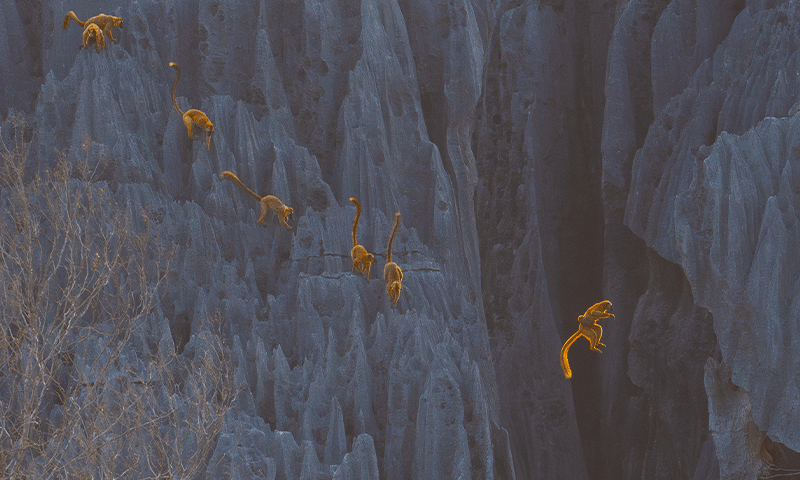
Lemurs are remarkably lithe creatures. With long tails providing balance and powerful, slender limbs outfitted with opposable thumbs and toes, they move with ease through the craggy limestone spires of western Madagascar’s Tsingy de Bemaraha National Park. Still, leaping over a 100-foot ravine with a baby clinging to your back seems like a daring choice.
To capture this scene, photographer Zhou Donglin had to do some mountaineering of her own. Setting out before sunrise, Donglin spent an hour scrambling to the top of a rocky peak, praying that the elusive brown lemurs (Eulemur fulvus) would show. After a day of disappointingly distant sightings, Donglin finally found some luck as a small troop descended through a forest of stone, glowing gold in the late evening light.
The photo was the grand prize winner in the California Academy of Sciences’ BigPicture Photography Competition, now in its 12th year.
In November, when this photo was taken, animals and plants in Tsingy de Bemaraha are nearing the end of a long dry season. After months of minimal rainfall, brown lemurs shift their diets from various fruits to the watery leaves of low-growing plants. This change comes at a vulnerable time for female lemurs, mere weeks after they’ve given birth.
With their babies still nursing and unable to travel on their own, the mothers must strike out in search of sufficient water and nutrients—even if that quest requires a bold leap or two along the way. 
This story is adapted from an article that appeared in bioGraphic, an independent magazine about nature and regeneration powered by the California Academy of Sciences.