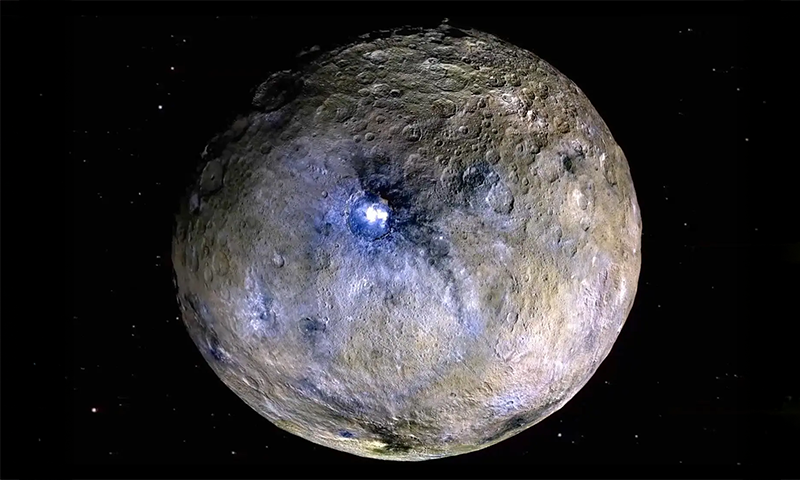
In the millions of miles between Mars and Jupiter spins a dwarf planet, now seemingly as cold as the many other asteroids around it. But it likely wasn’t always thus. New research digs into the history of the dark micro-planet and finds that it might once have had a hot core. And that, posit scientists, could have heated the carbon-heavy, rocky world enough to sustain a liquid water ocean—and with it, microscopic lifeforms.
Observations collected from NASA’s Dawn mission suggest that the asteroid was once heated from within by radioactive decay. This could have infused its oceans with warmth, as well as dissolved gases—including methane and carbon dioxide—which could have fed undersea organisms. The result might have looked similar to hydrothermal vents on Earth, creating “a buffet for microbes—a feast of chemical energy,” said lead author of the new study, Sam Courville, a researcher at Arizona State University, in a statement. The findings were published recently in Science Advances.
“Ceres’ ocean has likely become a cold, concentrated brine” lacking the energy to keep life alive, the study authors note. Its warmest era was likely some 4 billion to 2.5 billion years ago. Just when life seems to have been emerging on Earth. Now, Ceres is covered by a shell of ice some 30 miles thick. But as new observations roll in, they might heat up the search for the history of life in our solar system. 
Lead image: NASA/JPL-Caltech/UCLA/MPS/DLR/IDA