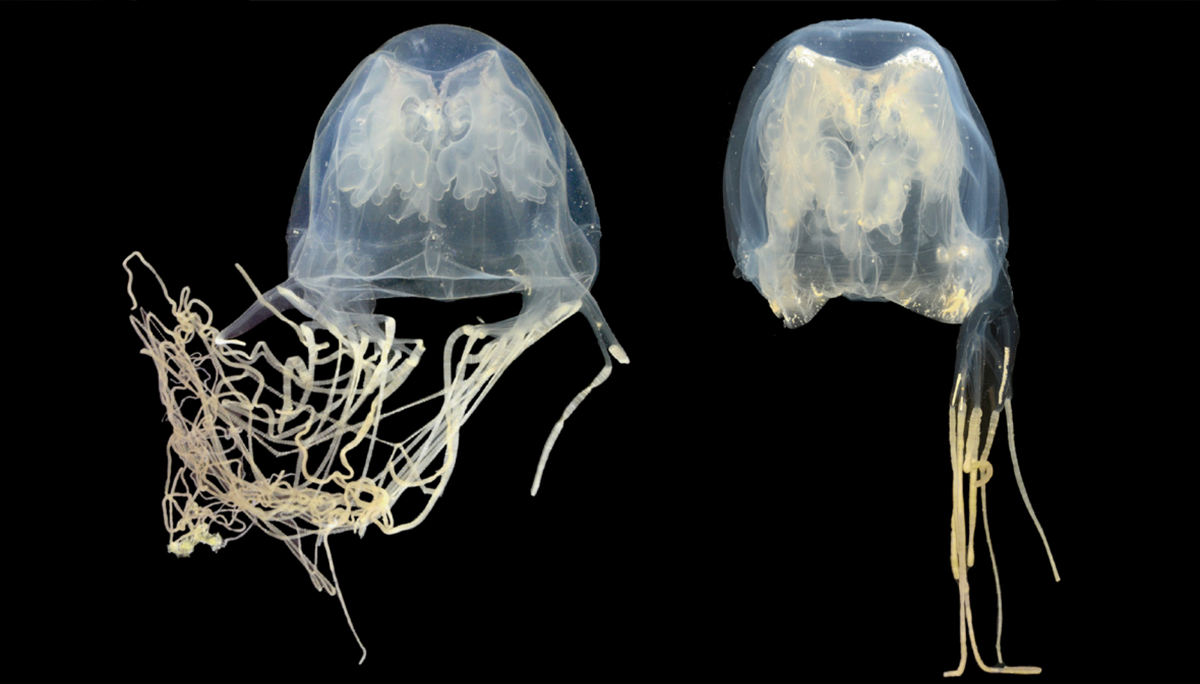
Box jellyfish might look harmless, but they pack a powerful venomous sting that can cause excruciating pain, and even death. While masses of these “sea wasps” can threaten swimmers from Hawaii to South Africa, there are a lot of species that have gone undiscovered. Now, marine biologists have discovered a new species, describing it for the first time in the pages of Raffles Bulletin of Zoology.
Researchers from Tohoku University in Japan studying box jellyfish that washed up on Singapore’s Sentosa Island (also known as “Pulau Blakang Mati” or “Island of Death Behind”) named the species they found there Chironex blakangmati, the fourth discovered in the Chironex genus.
Read more: “Ode to the Jellyfish”
At first, it was difficult to tell the new species apart from an already existing species, Chironex yamaguchii, but luckily this new jellyfish was discovered by the same expert. “C. blakangmati looks remarkably like Chironex yamaguchii—a jellyfish species I first discovered in Okinawa while doing my master’s degree there,” study author Cheryl Ames said in a statement. “But we realized they were completely distinct. I actually went back to dust off an old sample of C. yamaguchii I still had in storage in Okinawa to help with the comparisons.”
The two were so similar it took a genetic analysis to reveal C. blakangmati was a distinct species, but the researchers were also able to identify key anatomical differences that will enable future researchers to distinguish it at a glance. Box jellyfish use muscular flaps on the bottom of their bell-shaped bodies to move, and the hinges on these flaps are reinforced by structures called “perradial lappets.” Unlike other members of the Chironex genus, C. blakangmati lacks canals that extend from these perradial lappets.
Of course, if you’re close enough to make the distinction it might already be too late. 
Enjoying Nautilus? Subscribe to our free newsletter.
Lead image: Iesa et al.