In 2019, a 4.5-billion-year-old meteorite that crashed to Earth in the Sahara Desert surfaced in Mauritania. It turned out to be an extremely rare angrite—one of only 68 known specimens out of roughly 80,000 meteorites discovered. It also had a wild story to tell, according to research recently published in Earth and Planetary Science Letters.
Angrites are aluminum-rich meteorites with no known parent body in the solar system, so scientists at the University of Colorado Boulder were eager to study composition of this angrite to determine its origin. Chemical analysis revealed that it formed under intense pressure—17.5 times more pressure than exists even at the bottom of the Mariana Trench. The physical characteristics of the crystals inside the meteor, however, suggested that it formed at a shallow depth.
Read more: “The Madness of the Planets”
Putting both pieces of the puzzle together, the researchers determined it must have been formed within a celestial body much larger than an asteroid—a protoplanet roughly the size of the moon. According to the researchers, it’s the first definitive proof that this protoplanet, the angrite parent body, existed in our early solar system.
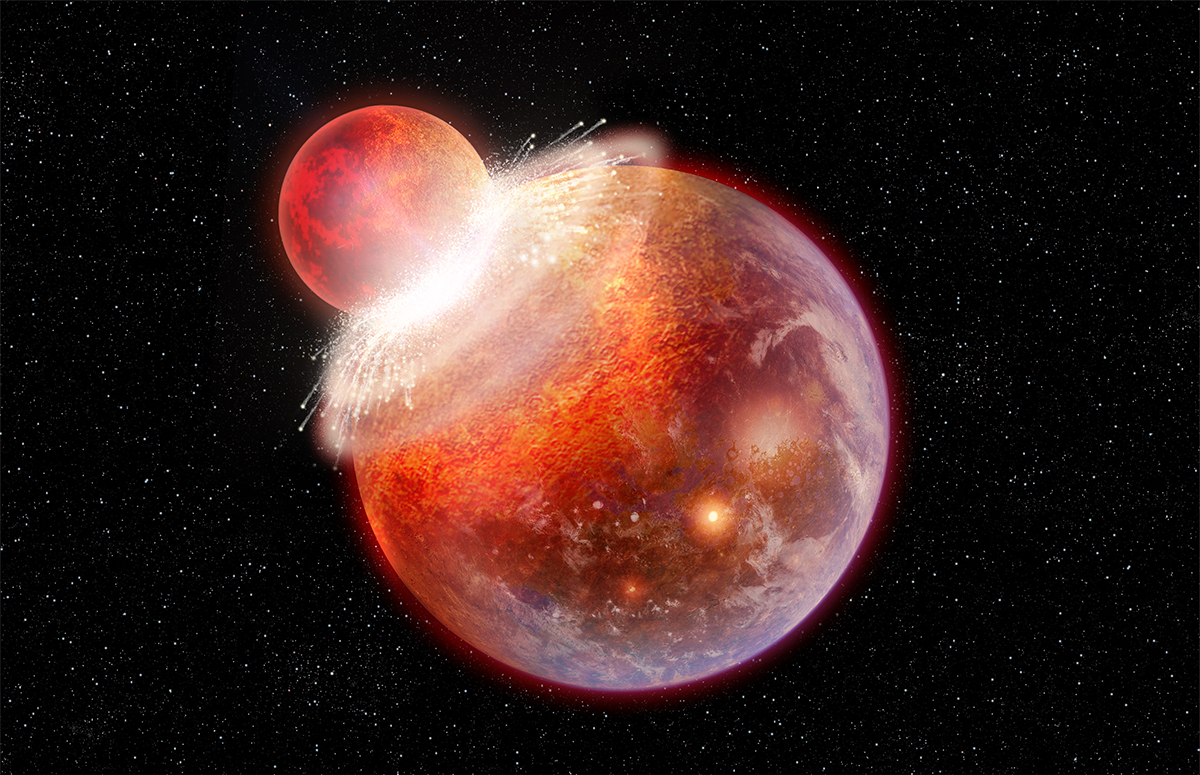
Of course, it’s not here now, which indicates that at some point billions of years ago it broke apart, likely due to a collision with another object when our solar system was still young. “It’s incredible to think there was once a world this large,” study author Aaron Bell said in a statement. “We only know it existed because a few fragments of it happened to land on Earth.” 
Enjoying Nautilus? Subscribe to our free newsletter.
Lead image: Pavel / Adobe Stock