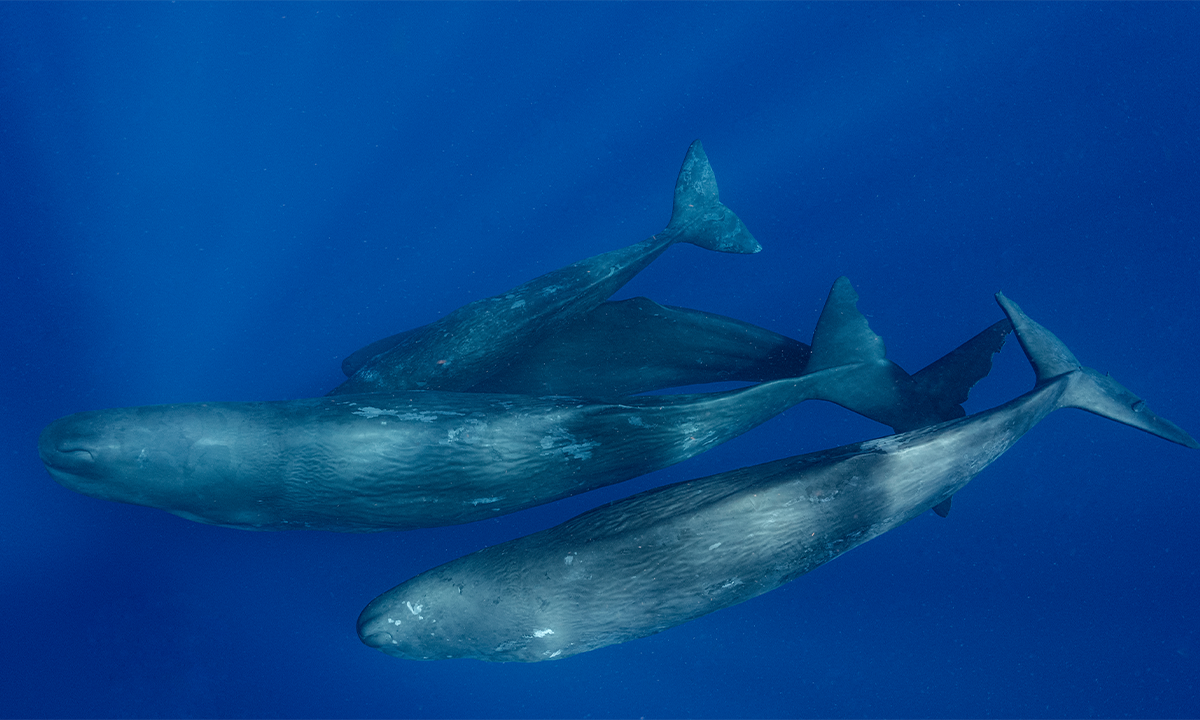
From a whale-watching boat, you’re most likely to spot humpbacks, minkes, or fin whales. Conversely, because they spend so much time so deep in the ocean, sperm whales are rarely visible, such that some details of their lives have remained a mystery.
Case in point: Like other toothed whales, sperm whales (Physeter macrocephalus) are presumed to maintain cooperative social groups of females, but specific incidences of such cooperation have rarely been observed. Now, though, whale biologists from universities in Poland, the United States, Belgium, Israel, and the United Kingdom have documented how female sperm whales work together during a birth. They published their findings today in the journal Science.*
The researchers analyzed drone footage of a surface gathering of 11 sperm whales off the coast of the Caribbean island of Dominica. They knew that the gathering included two extended family groups of whales that usually forage separately. But in this instance, the groups met and stayed together on the surface for several hours.
Read more: “Do Whales Have Culture?”
The drone footage revealed a mother whale delivering a calf, after which adult females from both families surrounded her and helped the newborn. (Because newborn whales have limited control over their buoyancy, they require physical support to breathe.) For about an hour, the females took turns pushing the newborn to the ocean surface. Machine-learning analyses of whale identities, positions, and orientations over time showed that they clustered together right after the birth, suggesting “spatially coordinated physical interactions in supporting the newborn,” according to the study authors.
You might expect a whale’s direct kin to participate in a birthing event, but in this case, all members, regardless of family group, helped with the baby, “suggesting a pattern of flexible, role-based coordination rather than strict kin-based caregiving.” The most active supporters were the mother, her half-sister, and an unrelated juvenile female. The elder females—that is, aunts and grandmothers—were less involved, seemingly focusing on other calves.
In fairness, though, a little peace and quiet from the rest of her kids can be a big help to a new mom, too. 
Enjoying Nautilus? Subscribe to our free newsletter.
Lead photo by Amanda Cotton / Ocean Image Bank
*As originally published, this article misstated the name of the journal the results were published in. This has been corrected in the story above.