There’s a surprising natural rhythm to visiting other worlds. If you sit down with pencil, paper, and enough of an aptitude for orbital dynamics you’ll soon discover that the easiest, most efficient trajectories to take us from Earth to a place like Mars involve great elliptical arcs around the sun. But these pathways (called Hohmann transfer orbits) require good timing, so that when we arrive at the orbit of Mars the planet is also there at that precise moment and not tens of thousands of miles away.
Consequently, there is a season for going to Mars, and this year sees no less than three missions vying for a chance to explore another world, and launching within weeks of each other. The United Arab Emirates Space Agency has its Hope orbiter (aiming to study Mars’s atmosphere), China has the Tainwen-1 mission (with no less than an orbiter, a lander, and a rover) and the United States has NASA’s Mars 2020, consisting of the rover Perseverance and a helicopter demonstrator called Ingenuity.
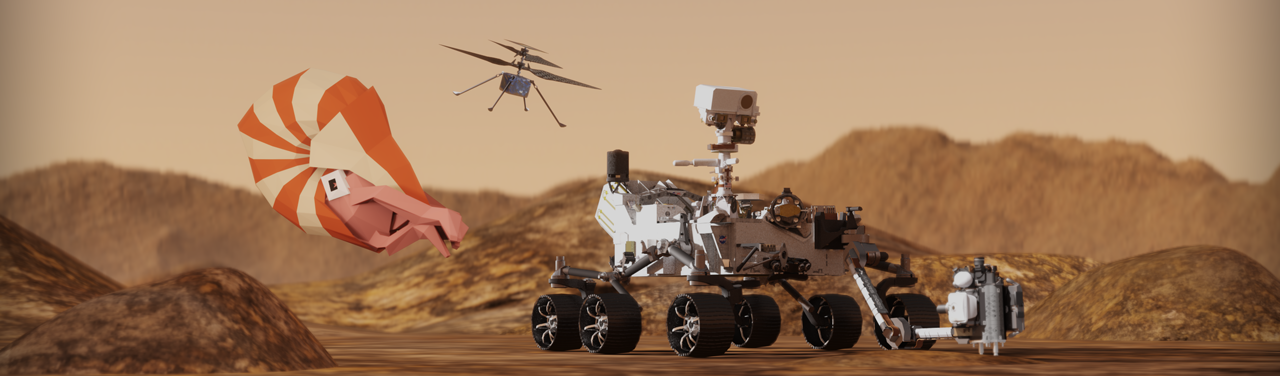
Perseverance is in all ways a technological child of previous explorers. From the diminutive Pathfinder rover back in 1997 to the twin sisters Spirit and Opportunity, and the still-roaming Curiosity—the effective older sibling of Perseverance in design and scale. That scale is something to behold too. Perseverance is about 10 feet long, 9 feet wide, and a looming 7 feet tall. Add in its long moveable robotic arm and its passenger—the whirring meter-wide solar- powered Ingenuity—and this machine has a presence at the extreme end of the exploration avatars we have placed on other worlds in our solar system.
Yet few of us get to feel that presence, that sense of otherworldly connection to a robot that is in all ways a surrogate for having our own feet on the Martian regolith. Technology can help make that connection. Through augmented and virtual reality, we can both bring a machine-like Perseverance into our world (into our living rooms even), and project ourselves to be with it on the surface of Mars—becoming, in effect, a Martian ourselves.
As you enter the augmented Mars below, you will be near the Perseverance rover. Move around with a joystick and explore the rover and its surrounding landscape. (You can explore in virtual reality if you have the appropriate equipment.) Once inside, click on the information posts. By the way, don’t be afraid of the nautiluses floating around. Those are just avatars of other visitors. They can see but can’t hear you. Make yourself at home.
Caleb Scharf is an astrophysicist, the director of astrobiology at Columbia University in New York, and a founder of yhousenyc.org, an institute that studies human and machine consciousness. His latest book is The Zoomable Universe: An Epic Tour Through Cosmic Scale, from Almost Everything to Nearly Nothing.
The mission of OmniScope.org is to experiment with novel methods of science communication. Current explorations are focused on the media of virtual worlds and immersive technologies.