On today’s date (July 24) in 1991, British physicist Andrew Lyne claimed to have discovered the first planet outside our solar system—an Earth-shattering announcement following centuries of inquiry into the mysterious depths of space. Lyne, a researcher at the University of Manchester, and his colleagues had turned their attention to a pulsar, the remnant of a huge, dead star, which regularly blasts beams of radiation. After noticing weird shifts in the timing of the pulses, Lyne’s team suspected the gravitational pull of an exoplanet could be the culprit. A new era of space exploration was born—or so they thought.
The following winter, Lyne took it all back. A week before the January 1992 meeting of the American Astronomical Society, Lyne realized that he and his co-authors had blundered, and he decided to admit the exoplanet error to hundreds of his peers at the event. There, he explained to the crowd how he hadn’t accurately accounted for the impact of Earth’s elliptical orbit on the pulsar’s pulses. This skewed the data and gave the illusion of a world that wasn’t there. “The planet just evaporated,” Lyne said in his speech, which received a standing ovation.
But the astronomy community didn’t have to wait long to learn of the first real exoplanet—only moments, in fact.
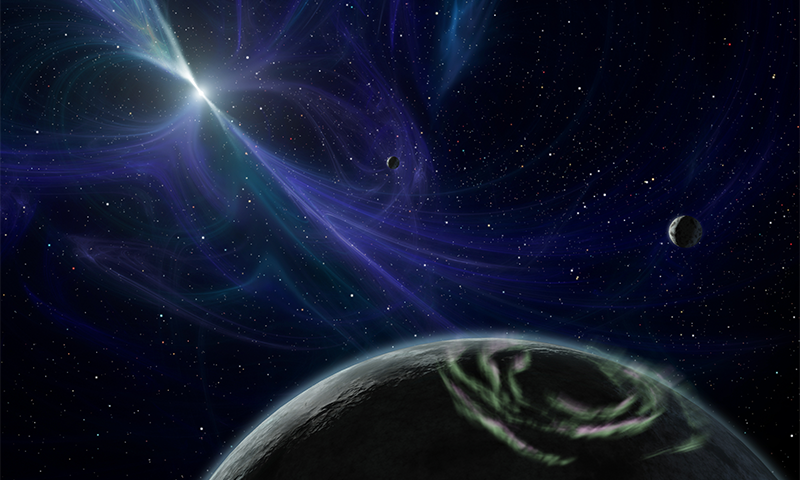
Right after Lyne owned up to his team’s mistake, then-Arecibo Observatory astronomer Aleksander Wolszczan took the stage. He and his co-author Dale Frail, of the National Radio Astronomy Observatory, had, in fact, glimpsed not one but two bona fide exoplanets—nicknamed Poltergeist and Phobetor—using the same technique used by Lyne’s team. Only Wolszczan and Frail’s math checked out. Two years later, Wolszczan pinpointed a third exoplanet, called Draugr, orbiting that same pulsar, known as Lich.
Wolszczan gave major kudos to Lyne, telling astrophysicist Mario Livio that his paper offered him a “confidence booster” and assured him “that the signals in his data were real.”
It was “the most honorable thing I’ve ever seen,” astrophysicist John Bahcall told journalist Michael D. Lemonick at the time. “A good scientist is ruthlessly honest with him- or herself, and that’s what you’ve just witnessed.”
When charting our universe and beyond, it turns out that false starts and fumbles—along with humility—are essential ingredients to new discoveries. 
Lead image: NASA/JPL-Caltech