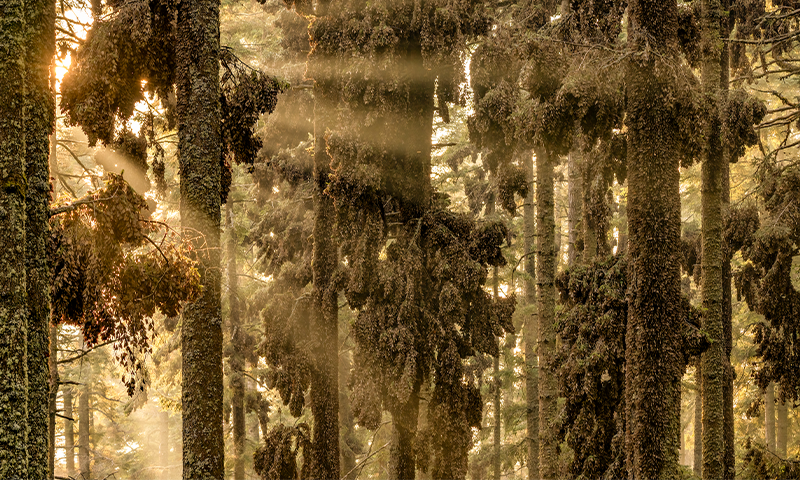
Upon first glance, this scene looks like little more than a sunlit patch of leafy trees. But those clumps hanging off branches and blanketing tree trunks are actually millions of monarch butterflies, huddled for warmth in one of Mexico’s famous overwintering sites.
Monarchs are the only butterfly species known to make a two-way migration to avoid North America’s freezing wintertime temperatures, traveling annually from summer breeding grounds down to the warm, humid climates of Mexico’s Sierra Madre Mountains—a journey that can stretch as far as 3,000 miles.
Tens of thousands of butterflies cozy up to generate warmth.
To this day, researchers have yet to understand what triggers the monarch butterfly’s epic migration. Yet every year, between October and March, monarchs form colonies at the exact same overwintering sites located in a small stretch of Mexico’s temperate, high-altitude forests. Tens of thousands of butterflies will cluster on a single oyamel fir tree, cozying up to generate warmth and conserve energy as temperatures dip.
Photographer Jaime Rojo captured this sunset scene on Michoacan’s Monarch Butterfly Biosphere Reserve, a UNESCO World Heritage Site and annual overwintering grounds for the iconic butterflies. The image was the grand prize winner in this year’s California Academy of Sciences’ BigPicture Photography Competition.
Though the orange-and-white insects are perhaps the most familiar butterfly species in North America, monarchs nevertheless face existential challenges from encroaching agriculture, climate change, and deforestation of their overwintering grounds. Their populations, monitored closely at the overwintering sites in Mexico, have taken a nosedive in recent decades.
Rojo’s image serves as both a stunning representation of the monarch’s epic migration, and a visual reminder of the close relationship these butterflies have with the oyamel firs they rely on to survive. 
Lead photo: This image originally appeared on bioGraphic, an online magazine about nature and regeneration and the official media sponsor for the California Academy of Sciences’ BigPicture Natural World Photography Competition.