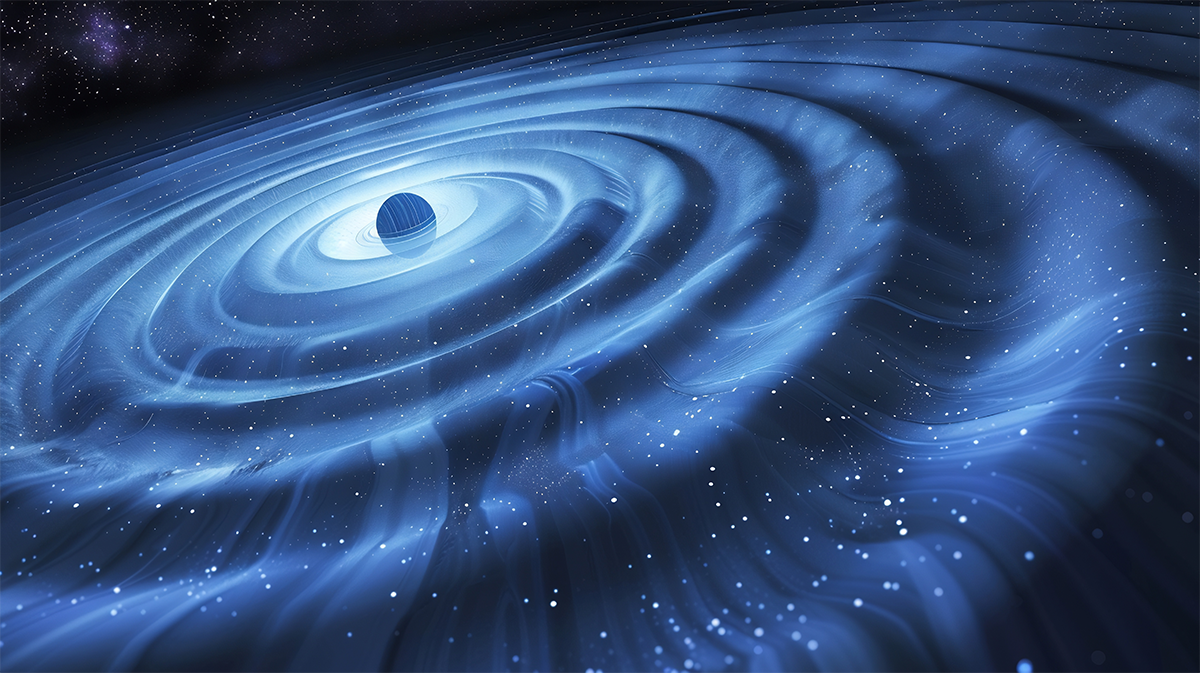
We can’t learn everything about the universe by pointing telescopes at the sky. Gravitational waves, for example, are invisible. These tiny ripples in the fabric of spacetime move at the speed of light, warping everything in their path, but because they’re so minute we don’t notice them. In fact, it takes incredibly sophisticated machinery to even detect them at all.
That’s where the Laser Interferometer Gravitational-Wave Observatory (LIGO) comes in. Completed in 2002, these two sprawling complexes (one in Washington state and the other in Louisiana) were designed to use powerful laser beams shining through miles-long tubes to measure distortions in spacetime as infinitesimal as a thousandth of the width of a proton. In doing so, they can offer clues about massive distortions in gravity that happen billions of light-years away, like the cataclysmic collisions between black holes.
Now, astrophysicists from Monash University in Australia have analyzed an extensive catalog of observations from both LIGO and an Italian observatory (Virgo) to shed light on the many different ways black holes merge.
Read more: “The Gravity Wave Hunter”
“This set of nearly 400 gravitational-wave detections from LIGO and Virgo provides us with a clear indication that the binary black hole mergers we see are forming in several different ways,” Sharan Banagiri, co-author of a study on the data (available in preprint), said in a statement. “Some might form as one giant cloud of gas that collapses to give two massive stars that then become black holes. Others might be black holes that wander into each other in dense environments called clusters that are packed with stars. While others are the product of a previous generation of mergers between two black holes.”
The researchers discovered that many of the black holes were spinning at a neck-snapping pace—several thousand times per second. These black holes were likely “hierarchical.” Rather than a single star that’s collapsed into a black hole, they contain the remnants of other black holes they’ve gobbled up on their cosmic journey. According to the researchers, these hierarchical black holes are more likely to merge with lower mass black holes.
It’s an exciting treasure trove of data, and it shows just how far LIGO has come. When the observatories came online in 2002 gravitational waves were still theoretical, and they didn’t detect a single peep from the cosmos for 13 years. “We are no longer just looking at individual anomalies, instead, we are seeing a true kaleidoscope of cosmic collisions,” study co-author Eric Thane said. “We are pushing the edges of what we know, seeing things that are more massive, spinning faster, and more unusual than ever before.”
Stand by for the universe to get even weirder. 
Enjoying Nautilus? Subscribe to our free newsletter.
Lead image: Muhammad / Adobe Stock