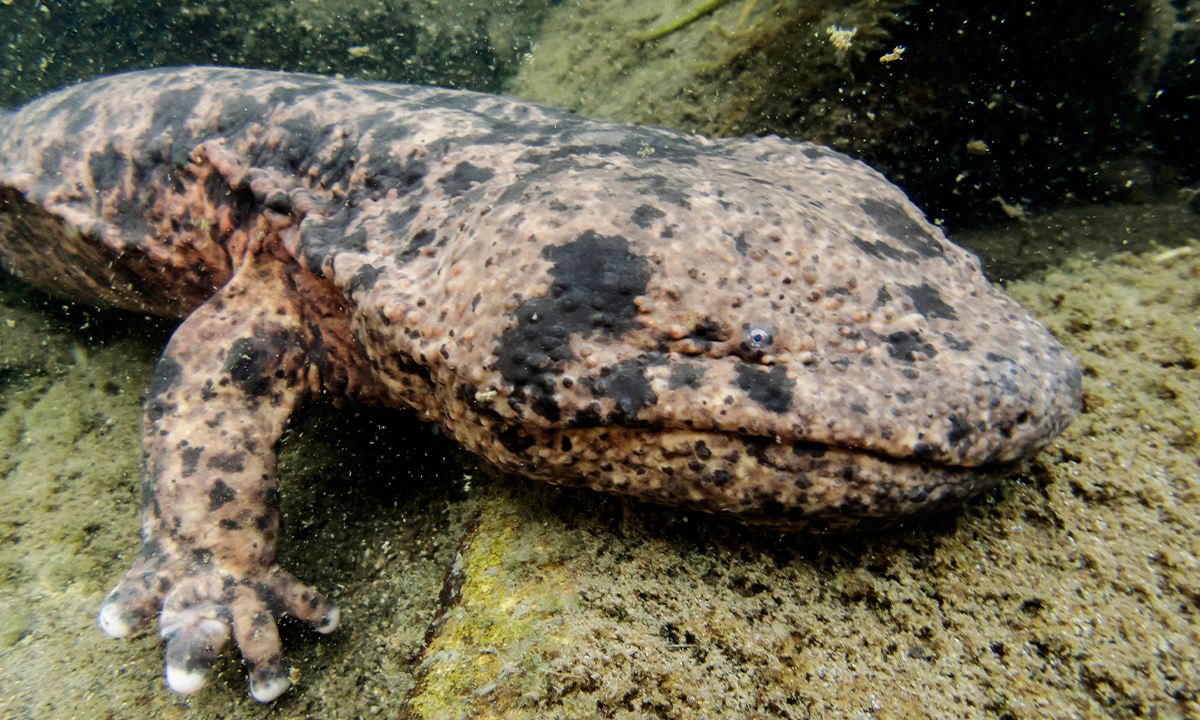
There are monsters lurking in the rivers of southern Japan—giant salamanders that can grow up to five feet long. Second only to their Chinese cousins, these wet-skinned leviathans are some of the largest amphibians in the world. New research into their diet published in Oikos reveals they have a monstrous appetite to match, and one that changes dramatically over their lifetimes.
To study the feeding habits of the Japanese giant salamander, a team of researchers led by study author Clément Duret of the Laboratory of Ecology and Conservation of Amphibians at the University of Liège in Belgium headed to the Ichi River in Hyogo Prefecture. There, they trudged along the riverbanks, plucking up 160 of the beasts, measuring them, and flushing their stomachs to take a peek at their meals.
Read more: “In the Land of the Eyeless Dragons”
As the salamanders leveled up their size, they leveled up their rank on the food chain, or trophic position, the researchers found. “The results reveal a spectacular dietary transition,” Duret explained in a statement. “Young, small salamanders feed mainly on aquatic insects. Their trophic position is similar to that of secondary consumers, an intermediate level in the food chain, as is the case with most salamanders.”
Once the giant salamanders crossed the two-foot mark, they were able to feast on crabs, frogs, and fish, catapulting them to apex predator status. This ability to capture larger prey without becoming prey themselves gives them an incredible adaptive advantage, fueling the evolution of stronger jaws and a larger body size.
The team hopes these new insights will aid in conservation efforts of the species, which is unfortunately flagged as vulnerable.
It can definitely be lonely at the top of the food chain. 
Enjoying Nautilus? Subscribe to our free newsletter.
Lead image: Martin Voeller / Shutterstock