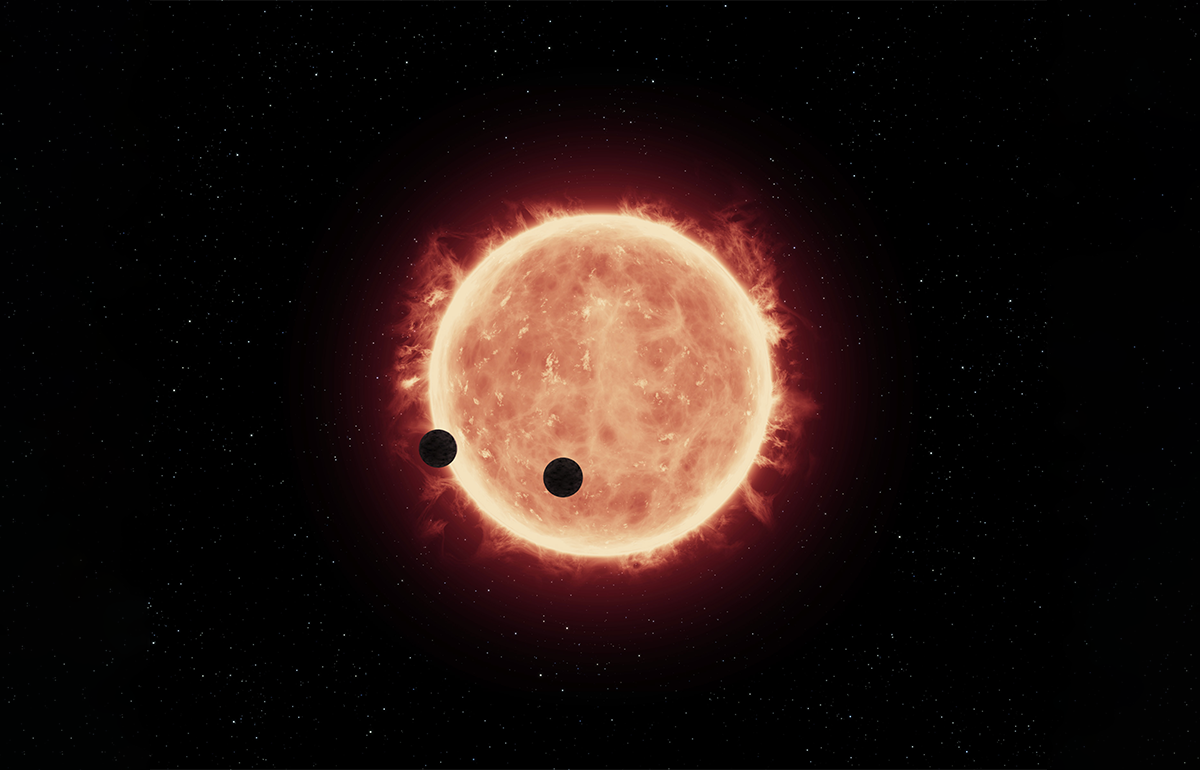
We’ve got around 5 billion years to plan for it, but at some point the sun is going to expand into a red giant and engulf the inner planets—up to and including the Earth. Now, new research published in the Monthly Notices of the Astronomical Society finds evidence that red dwarfs, much smaller, younger, and dimmer stars, are already capable of devouring Earth-like planets.
Surveying thousands of stars, a team of British astronomers identified six red dwarfs in three separate clusters with a chemical signature indicating a significant amount of lithium—an element that shouldn’t be there. “Red dwarfs are smaller and cooler than our sun but inside they’re extremely hot,” study author Robin Jeffries of Keele University said in a statement. “This heat should destroy all of their fragile lithium in nuclear reactions shortly after they form.”
Read more: “A Step-by-Step Guide to Our Solar System’s Demise”
According to the researchers, the high levels of lithium most likely came from the red dwarfs swallowing up their rocky planets, probably early in their development. The accretion of lithium detected suggests these stellar meals may have been three to 10 times the mass of Earth.
This planet-eating activity has long been theorized, and researchers say it may have even happened in our own solar system. If the lithium chemical signature is in fact from “eating” planets, the finding will open up new avenues of research into early planetary systems, allowing researchers to investigate when and how much planetary materials these stars consumed.
You are what you eat, even when you’re a star. 
Enjoying Nautilus? Subscribe to our free newsletter.
Lead image: NASA, ESA, and G. Bacon (STScI)